

Most architects focus mainly on the big picture of their designs.
A project’s footprint, floor plans, main volumes, and facade are what make a building a building anyway, a structure that can make space for human inhabitants, deny entry to the wind and rain, and stand stable above the groundwater beneath.
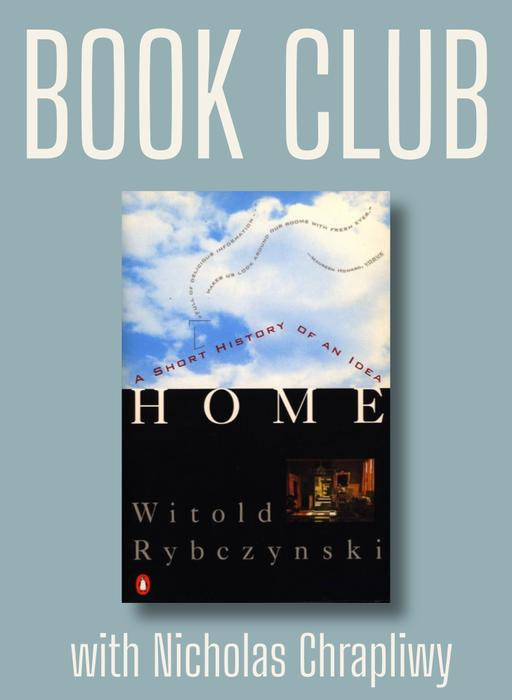
In his 1986 book Home: A Short History of an Idea, Witold Rybczynski (VEE-told rib-CHIN-ski) gives us his architectural perspective on the cultural and technological innovations that have shaped the idea of “home” from the medieval period to the modern day. In the course of ten chapters that feel like a comfortable stroll through the rooms of history, Rybczynski illuminates an idea that we take for granted in modernity: that home is the place where one is comfortable. In an organization of advocates for better cities, such an idea provokes another one that we are seeking to realize; an idea that we hope our children and grandchildren will take for granted themselves: that a city, too, should be built to feel like home.
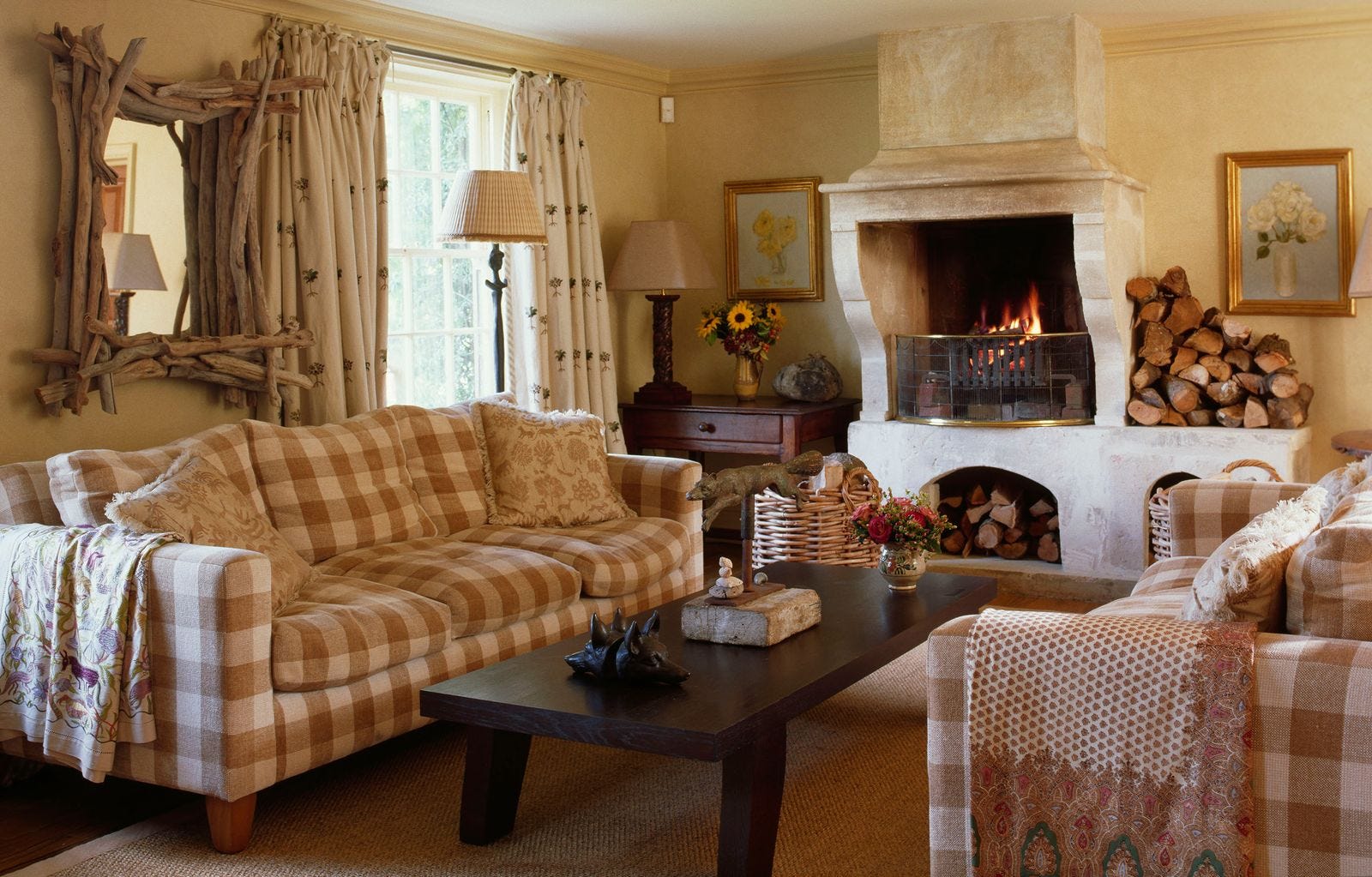
Rybczynski begins Home with a reference his American readers in 2026 are likely just as familiar with as those in 1986: Ralph Lauren’s interior decorations, which had recently debuted in four different collections. The interesting thing about these collections is that they weren’t on the cutting edge of sleek and edgy forms; instead they hearkened back to a nostalgia for prior eras of wicker, curve, carpet, and comfort. When the reader inevitably asks why this is the case, a door is opened to understanding the several centuries of innovation that led up to our own times.
Our first step through that door transports us back to the medieval period, when a home was something that would appear completely uncomfortable and strange to us today. While the feudal peasantry lived in cold, wet, and animal-ridden structures, the nobility “didn’t so much as live in their houses as camp in them,” rolling up their tapestries and packing their moveable furnishings whenever they wanted to travel and stay in one of their other estates. This wasn’t the most unusual thing about them, however. What would have surprised a modern homeowner about these places wasn’t their transience, but the presence of every kind of human activity all taking place in one great room, from business to dining to cleaning and housework, to the effect of a total absence of privacy. It wasn’t until the economic conditions of feudal Europe shifted to produce a class of wealthy mercantile homeowners in the form of the bourgeois, the Bürger, and the borghese that greater privacy and stability eventuated in the first form of what we now think of as the family home.
Rybczynski walks us through the rooms of the Dutch, the French, and the English as each national culture innovated on the possibilities for the ever more private domain of the home.
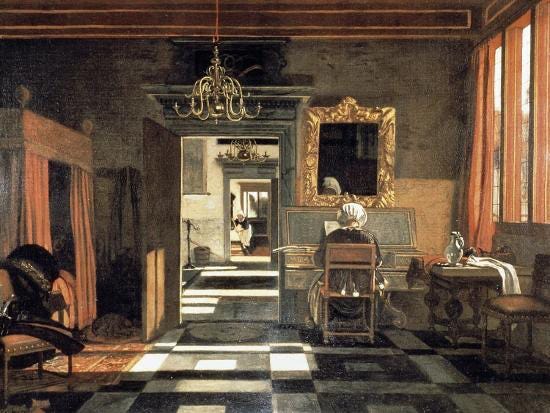
The Dutch predisposition against the French use of servants and house staff and toward greater social equality meant that the homeowners themselves spent enormous amounts of time and energy on the cleanliness of their abode. The humidity and frequent flooding in the Netherlands made the necessity of such an attitude toward scrupulous hygiene even more significant.
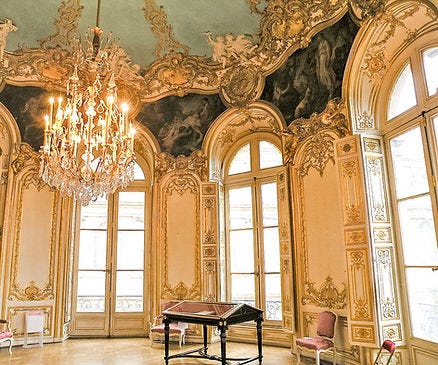
The French courtly emphasis on pleasure considered the Dutch styles too drab and austere, instead creating one of the first true interior styles of rococo awash in ornamental decoration pleasing to the eye.
And in the typically English way of synthesizing the Teutonic and Frankish sensibilities, the stately homes of England adopted a pragmatic aesthetic that stopped short of the French excesses but went past the Dutch austerities. These estates embraced the pleasurable experience of sitting on upholstered furniture instead of bare wood. This synthesis developed into the uniquely English taste for comfort, evidenced in Jane Austen’s use of the term in her 1815 novel Emma.
“Ah! there is nothing like staying at home for real comfort.” — Jane Austen, Emma
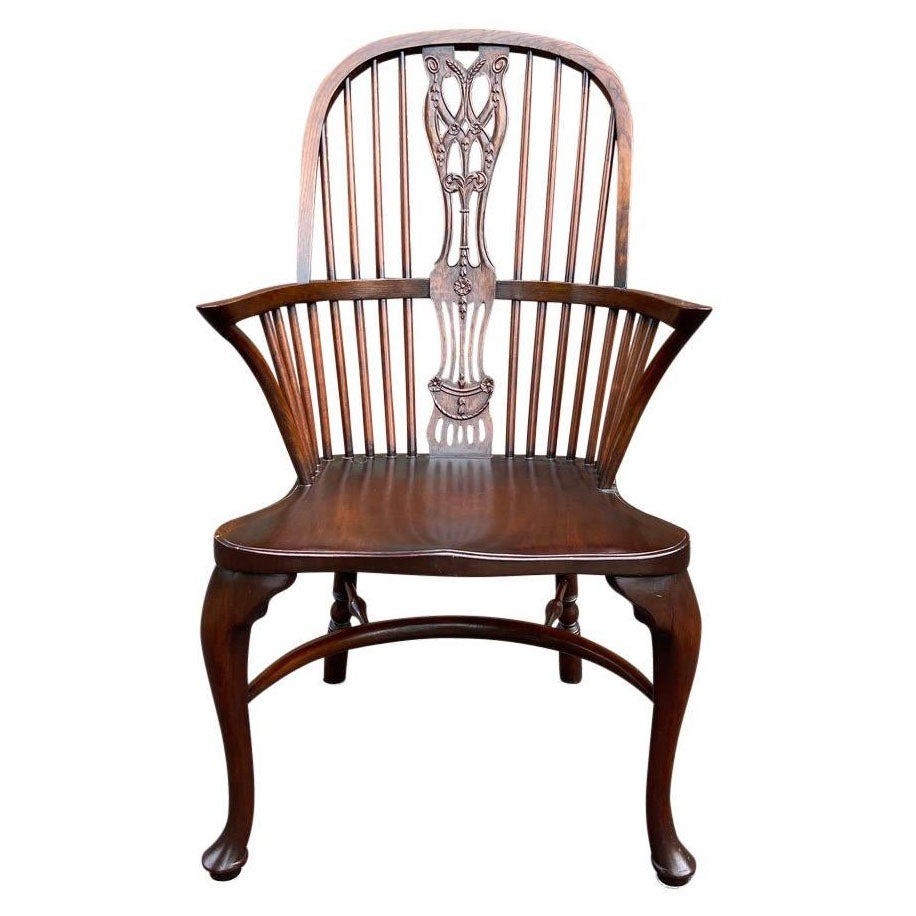
Out of this English innovation in taste came the engineering innovations of Thomas Chippendale and George Hepplewhite, who created timeless pieces of furniture like the Windsor chair that survive in popularity today, including in the Ralph Lauren interior collections mentioned above.
The innovation of domestic privacy and comfort may seem obvious to us today, but it unlocked economic interest in technological innovations that increased the feasibility and magnitude of both. Much of the second half of Home details the progression of residential lighting (from candles to gas lamps to light bulbs), heating (from hearths to stoves to radiators), and clean air (from open windows to filtered and forced air vents). Industrial America led these advancements in domestic innovation. Usually, only the richest American households employed servants, leaving ample opportunity to invent and market products of comfort to middle and lower class households. Women especially led advances in making homes places where one was not only comfortable sitting and reading, but also comfortable getting things done in the industrious way Americans love to do (see Christine Frederick and Mary Patterson’s works).
In the early years of the twentieth century, the home was beginning to reach a stage of near peak privacy, comfort, cleanliness, and efficiency, but a great rupture loomed on the horizon. The First World War brought about a sea change in aesthetic ideals that rejected comfort in favor of austerity once again, and relinquished privacy in favor of glass walls and panoptic viewpoints. Adolf Loos wrote ‘Ornament and Crime’ associating all domestic beautification with moral degeneracy, and Mies van der Rohe had iron cafe chairs in the interior of his venue at the Paris Expo for the Decorative Arts in 1925.
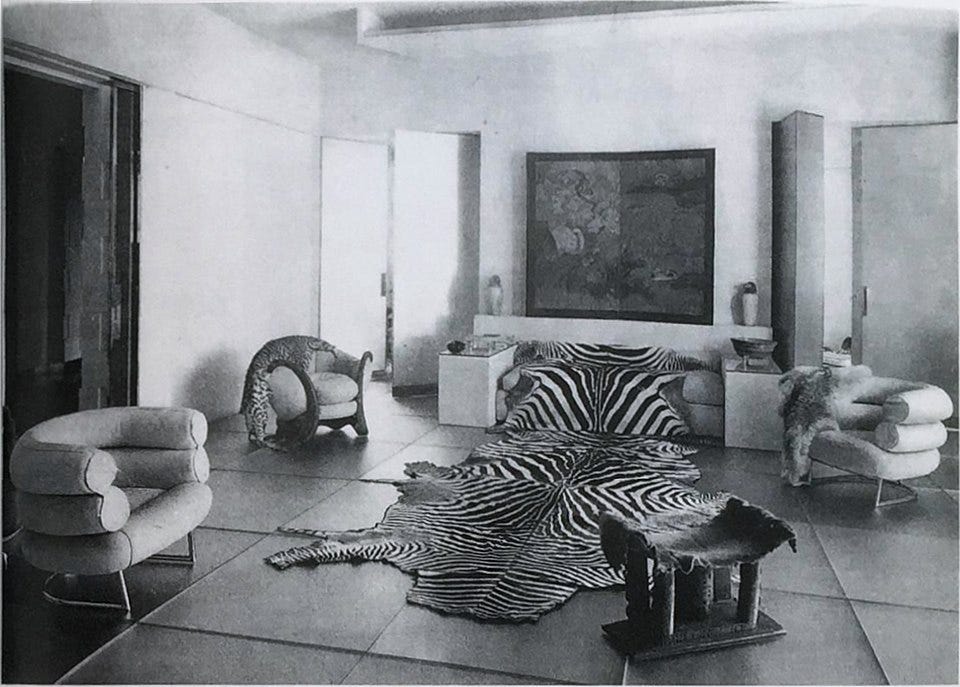
A conspicuous austerity and masculinity took hold among the modernists, and much of the Arts and Crafts movement in England and the Art Deco styles in France and America were rejected as indulgent, feminine, and associated with the old bourgeois world that had erupted into the most lethal and traumatic war of their lifetimes. The international styles yielded eventually to a softer minimalism, but the rupture was complete, and the idea of comfort would take decades to reestablish.
While discussing Rybczynski’s book with him, I learned that originally, he set out to write about the technological innovations of the home as a follow up to a prior work of his. To his surprise, he learned that comfort and privacy were not eternal features of the home but rather cultural innovations borne out of the material conditions of Europe. Residents of those cold and muggy regions sought out concepts of comfort and coziness that had little purchase in warmer climates. Witold remarked that trends in homes and the furnishings inside them operate on much longer cycles than fashions in clothing or music. What lasts even longer than these is the cycle of human evolutionary adaptations on the scale of many tens of thousands of years; this means that a chair or a couch designed to be comfortable four hundred years ago will likely still be so today, and will retain its comfort in four hundred years more. We live in essentially the same bodies as our distant ancestors, but thank goodness we don’t have to live in their homes.
With the perspective of such longevity in mind, Home carries deep significance for cities, not just private residences. Today as in ages past, people thrive in environments of privacy balanced with community and ergonomic ways to live and move in the world around them. City planning, public policy, legislation, zoning reform, and better transit are all means to the end of greater comfort in living, whether financial (housing affordability), physical (walkability and density), communal (third spaces), or economic (jobs) so that our cities, and not just our houses, feel like home.
We’ll end with the flourish with which every chapter in Home begins, i.e. a great quote from a great writer. In 1746, just as the innovation of comfort in the home was taking force, Samuel Johnson wrote aptly in The Rambler:
“To be happy at home is the ultimate result of all ambition, the end to which every enterprise and labour tends, and of which every desire prompts the prosecution.”
Join CITYBUILDER Book Club
📘 Home: A Short History of an Idea by Witold Rybczynski
📅 Mon Apr 13th 12:00pm - 1:00pm
📍 PRESS Coffee Crêpes Cocktails
400 Hillsborough St suite 108, Raleigh, NC 27603, USA
👉 RSVP here
Come for the ideas. Stay for the people who want to build a Triangle where everyone has a place to live. We’ll see you there.

Nicholas Chrapliwy (SHRAP-liv-ee) is a longtime member of CITYBUILDER who lives in Durham. He is the Executive Director at The Rhizome Institute, an organization cultivating sustainable relationships between the built, natural, social, and temporal environments through programs like the Great Green Exposition and The Rhizome Reports. After graduating from Duke in 2022, he led the creation of the Quad Arches, the new visual identities for the QuadEx undergraduate residential model, which were installed on the historic West Campus in 2025.