

This spring, nine students at NC State University have embarked on a mission to explore the past, present, and future of housing in Raleigh. Led by Professor Burak Erdim, these architects-in-training are surveying the suburbs that ring NC State, and conceptualizing how the urban fabric of Raleigh could be transformed by the legalization of single-stair housing, and the creation of “eco-districts”. Their findings highlight that single-stair housing could transform Raleigh’s fragmented, autocentric neighborhoods into walkable, sustainable, and nature-filled communities for all residents.

Defining “eco-districts”
The students in Professor Erdim’s class have chosen to explore single-stair developments in the context of eco-districts. According to urbanist Michael Eliason, eco-districts are compact, walkable, mixed-use urban neighborhoods that integrate environmental performance, social equity, and everyday livability at the neighborhood scale, not just the city-wide scale.
This piece was written by student fellows in collaboration with Single Stair NC.
Each semester, CITYBUILDER provides fellowship opportunities for aspiring student urbanists in the Triangle. This semester we’re focused on single-stair apartments. Single Stair NC is a new publication committed to advancing the pursuit of single-stair buildings in North Carolina.
In Eliason’s writing and advocacy, eco-districts are not isolated sustainable developments or luxury green enclaves. Instead, they are “dense, human-scaled neighborhoods designed to reduce car dependency while fostering strong social infrastructure.”
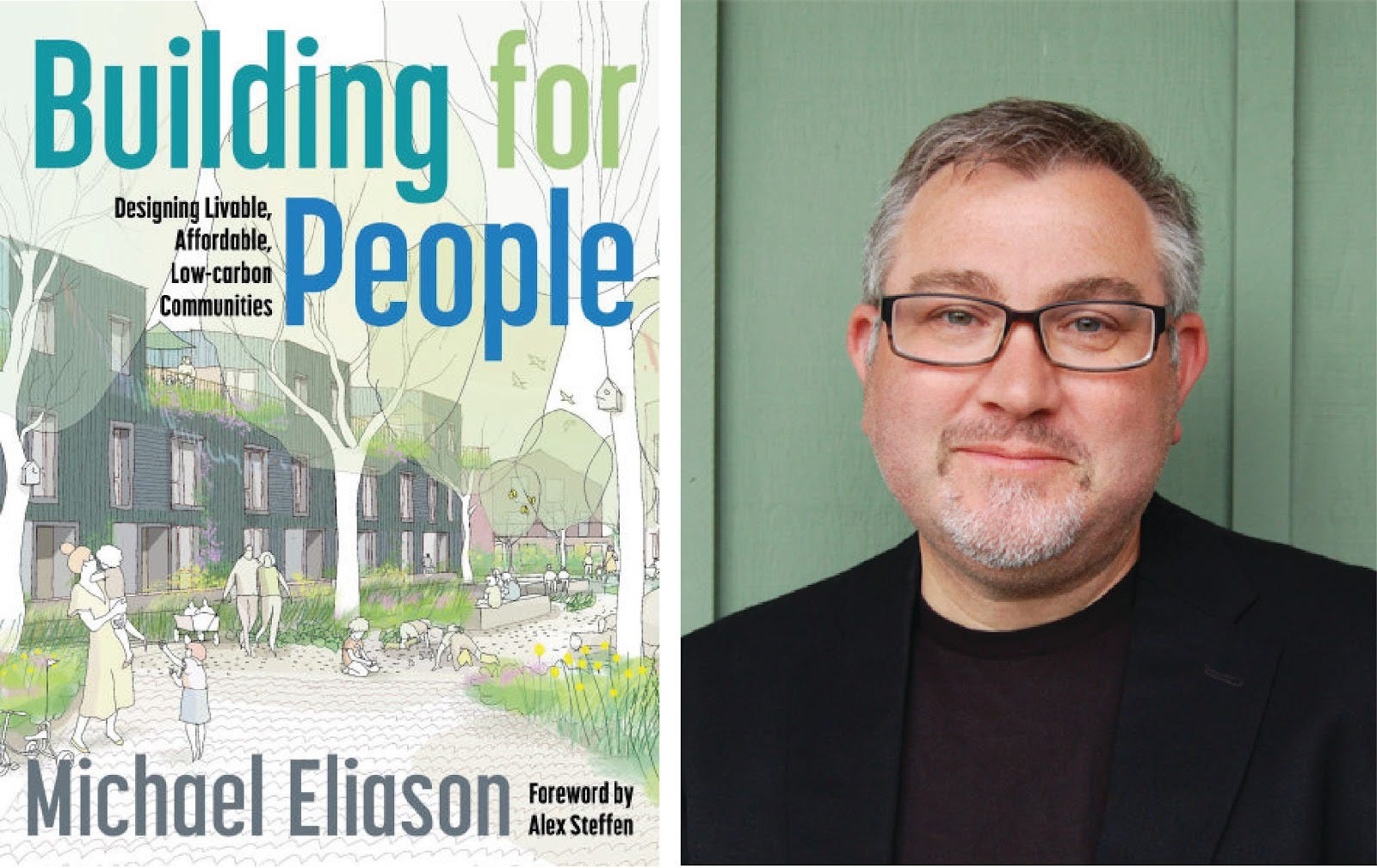
Eco-districts rely on mid-rise, small-footprint buildings, often 4-8 stories, with diverse unit types. This is where single-stair housing becomes central to the story. Instead of pointing to glitzy megaprojects, Eliason identifies European single-stair apartment buildings as the backbone of eco-districts, providing family-sized apartments, enabling small developer participation, and serving as incremental infill.
Density is essential to this vision… but not high-rise density. Instead, eco-districts call for “Goldilocks density”: enough people to support daily amenities within walking distance, but not so much scale that buildings become alienating. Parking is often consolidated or minimized so land can be used for housing, green space, or community services instead of flat asphalt.
“The goal is not to “ban cars” but to design neighborhoods where daily life does not require one.” - Eliason
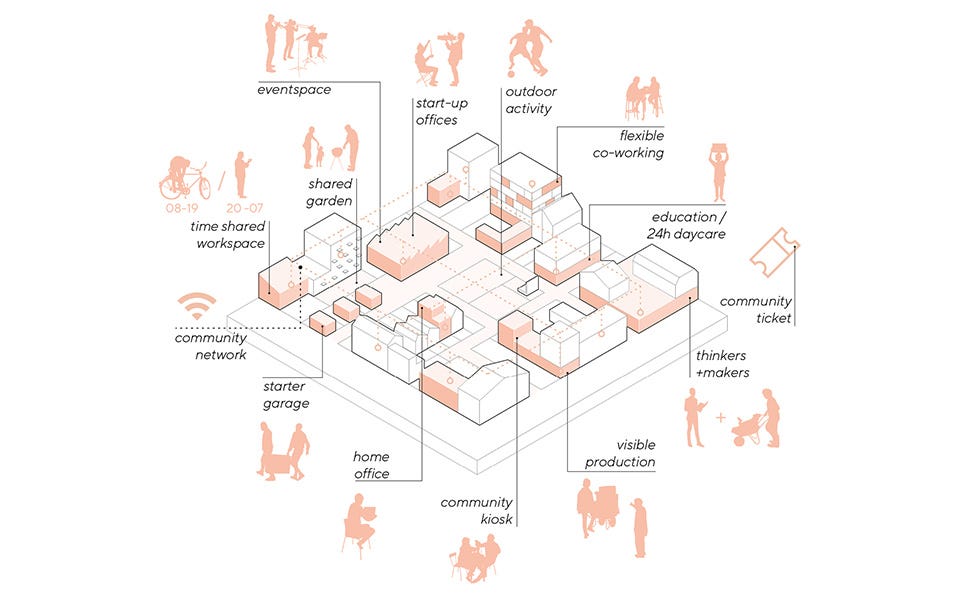
Eco-districts prioritize walking and cycling infrastructure, access to high-quality transit, and shared mobility options. Rather than separating residential, commercial, and civic uses into zoning silos, eco-districts mix them at a small scale.
Each student team focused on one of two goals: identifying and enhancing existing eco-districts in Raleigh through the addition of single-stair housing, or creating all-new eco-districts through the construction of single-stair housing. The following analysis of sites for single-stair construction is the first step of that design process.
The Single-Stair Studio’s Research
The teams of students conducted an urban analysis study of several neighborhoods in and around downtown Raleigh. Through their research, three consistent topics of interest became prevalent for what makes a strong single-stair site: urban mobility, cultural integration, and connection with green space. Let’s dive deeper into what those terms mean…
Urban Mobility - Cars, Parking, Cycling, Walking, and Public Transportation
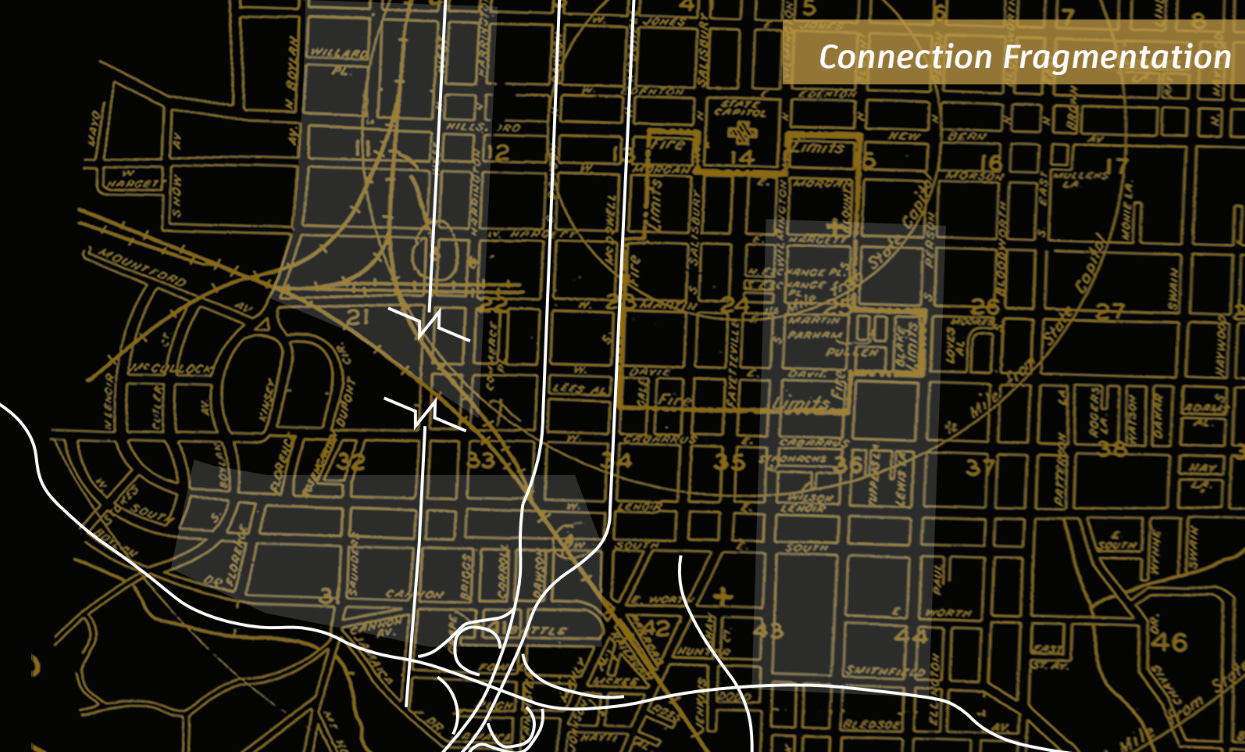
Transportation and mobility is one of the most important aspects of a successful and thriving city. Effective transportation systems enable people to access jobs, schools, healthcare, grocery stores, and other essential destinations. It’s critical that a city’s infrastructure allows people to live without sole reliance on automotive transit. Shelley Anderson outlined this concept well in her team’s project, titled Fragments to Nodes: “We can’t get rid of the highways and the railroads that have created the breakage, but we can bring pedestrian connections back into new developments”
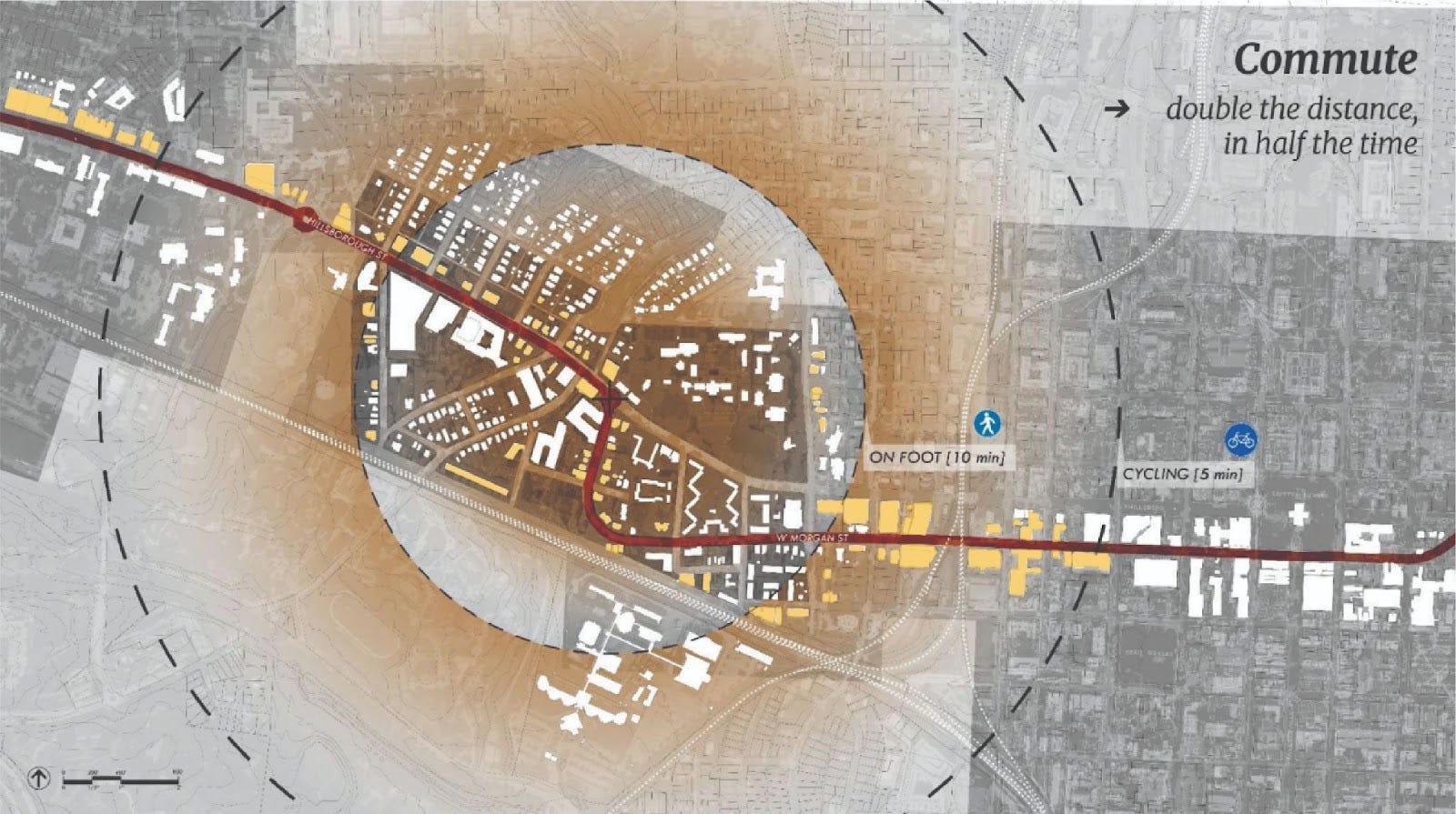
The smaller scale of single-stair housing is a goldmine for urban mobility. Infill lots between destinations could become viable housing for people who work nearby, and the mixed-use nature of single-stair would reduce travel distances for residents who work close by to where they live.
In another aspect of mobility, parking lots could become a key factor in the siting of single-stair housing. Following current parking requirements for residential buildings, a 24-unit single-stair building could require up to 48 parking spots onsite — far less than the 400 parking spots needed for a 200-unit double-loaded apartment structure. By nature, the small lots that are appealing for single-stair housing may not have room to accommodate all of the required parking spots. As a solution, students explored other sources of parking that could be utilized by single-stair residents.
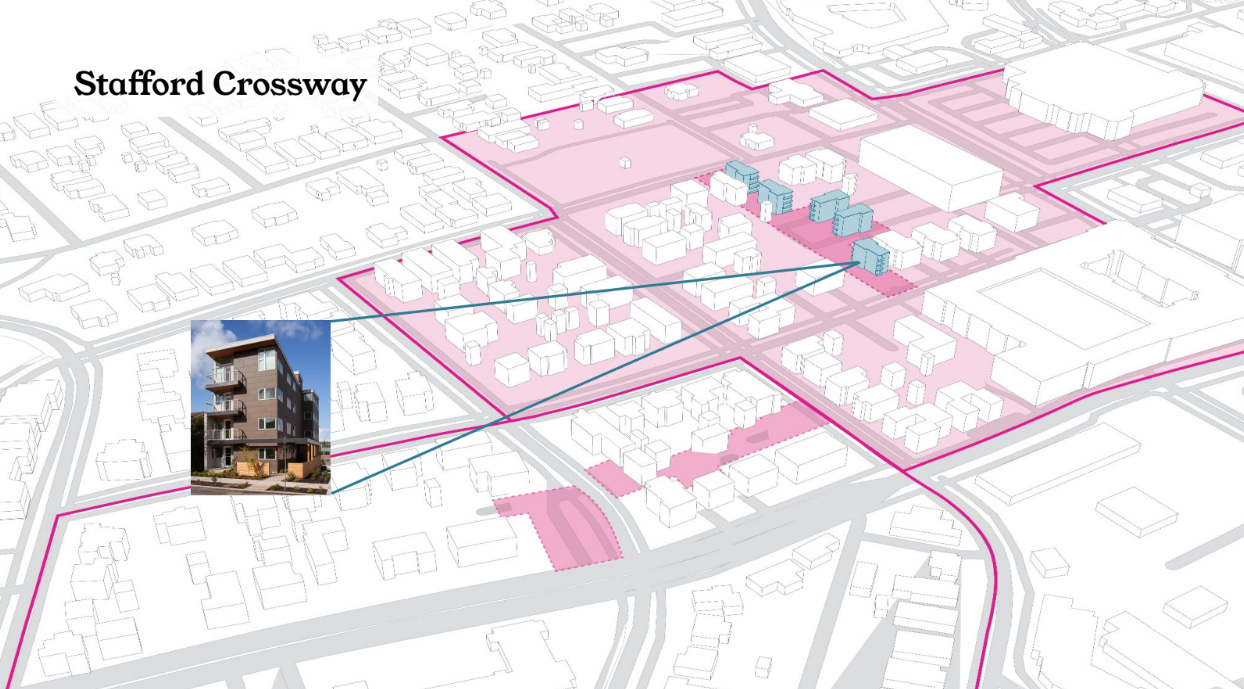
Many parking lots at popular shopping centers are packed during the stores’ business hours of 10am to 6pm, yet are empty outside of these hours. If single-stair housing was built adjacent to these parking lots, residents would likely be home from work after 6pm, and thus could utilize empty parking spaces. Phased daily parking, shared commercial/residential spaces, and even rooftop parking on aging strip malls could transition us away from car-dependent infrastructure toward walkable neighborhoods. Parking doesn’t need to be removed completely, we just need to be creative with how it can be utilized for the highest degree of efficiency — optimization, not eradication.
Cultural Integration: Preferences of Privacy vs Community
North Carolina’s architectural vernacular reflects climate and social patterns: porches, stoops, operable windows, and more. Yet many modern apartment buildings ignore this. The “first-floor problem” emerged as a recurring concern: ground-level units with windows directly facing sidewalks feel exposed. Privacy matters in Southern culture, where front yards traditionally buffer homes from public life.
Jasmine Mann and Divinity Hilton studied Clark Avenue and Chamberlain Street, asking critical “why” questions about the transitions between private and public space. Why are public sidewalks only ever adjacent to a road? Could certain pedestrian paths be fully separated from cars? Could alleyways become small plazas for adjacent neighbors to host gatherings?
More importantly, how should the first floor function in a single-stair building? Perhaps it should not always be residential. Many Americans value a sense of privacy that’s not often seen in single-stair buildings abroad. However, rather than striking down single-stair as a useful building typology, the students began to rethink what that first floor space could be used for. Retail spaces, mail rooms, laundry facilities, lounges, or coworking rooms could activate the street level while protecting privacy of private residences. A raised stoop or elevated entry, borrowing from brownstone traditions, could lift residential units above sidewalk level as well.
Particularly in the existing West Morgan eco-district analyzed by Nico Castilla Lopez and Ian Shore, a number of existing small businesses could be enhanced by integrating mixed-use single-stair buildings into the neighborhood. The existing condition includes a number of apartment buildings, a few single family homes, and several low-density, free-standing restaurants. By bringing single-stair here, walkable residential areas can be densified while adding additional amenities like small grocery stores, healthcare, or childcare. A mixed-use environment would increase the customer base of the existing local establishments, and in turn provide residents with vibrant streetlife and commercial activities.
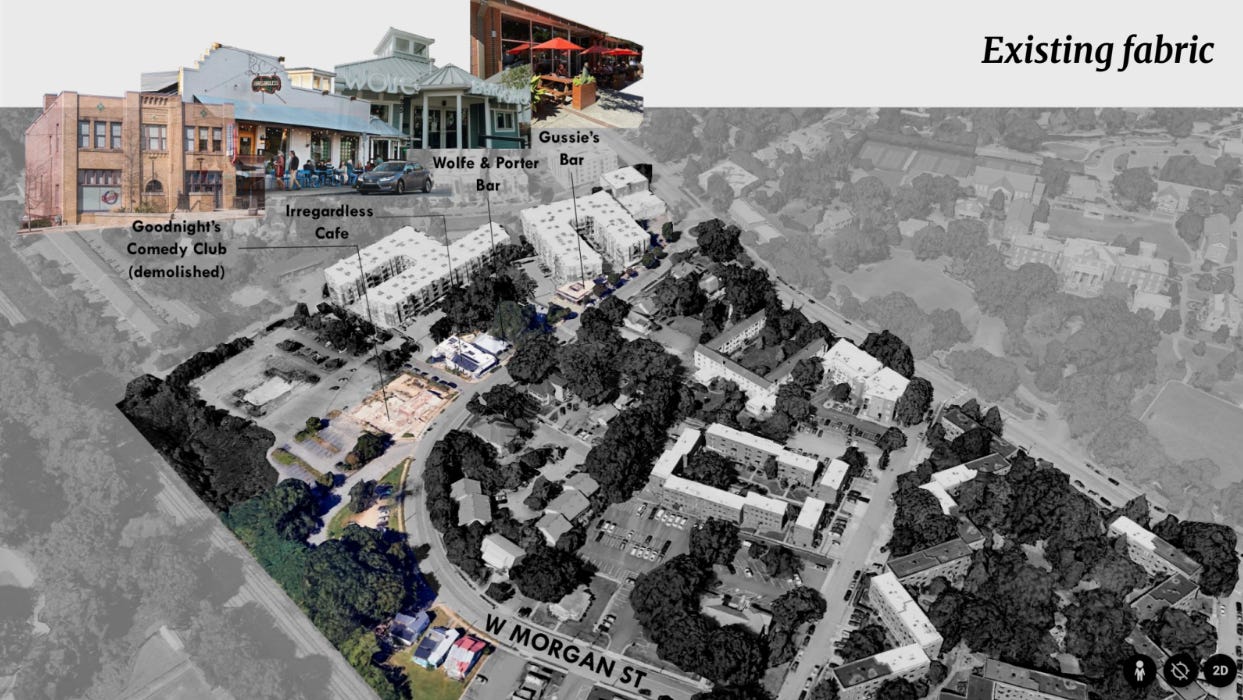
Many of the aforementioned restaurants and businesses feature a historic, vernacular architecture style, which could be borrowed by new construction to continue the character of the eco-district. As mentioned in our previous article, the vernacular traditions of North Carolina’s architecture are evident through the use of porches, pitched roofs, and operable windows, among other design moves. To build single-stair residences that look like they belong in North Carolina, developers can draw design elements from neighboring properties. Many infill lots are already present in Raleigh along corridors of historic homes, which is the perfect space for single-stair buildings to be added at a scale that complements the current architectural character.
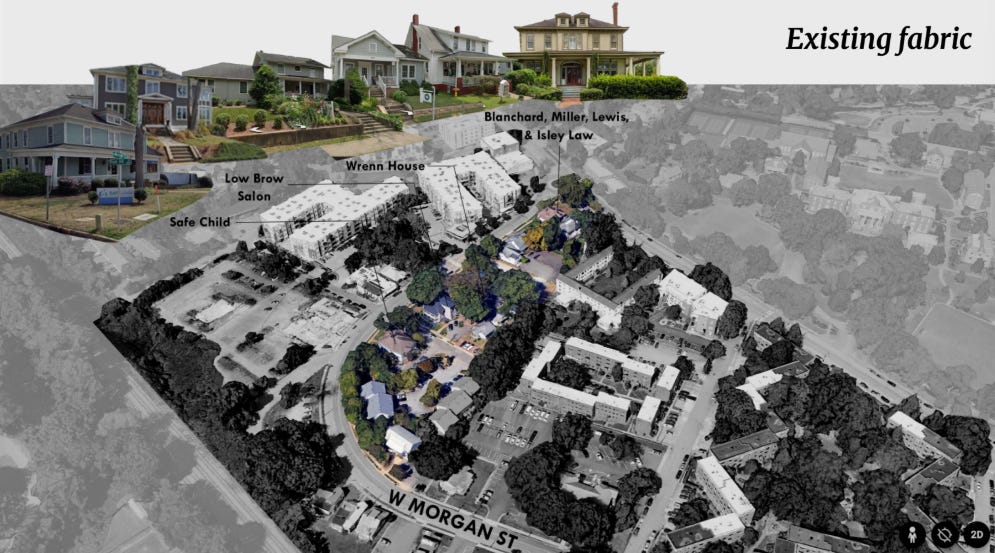
Single-stair homes provide a unique opportunity to incrementally increase density in these older, character-rich neighborhoods, without being overbearing in building height or lot size. The units themselves can feel comfortable and welcoming, with better daylighting and more chances to create usable outdoor spaces. The exterior designs of the buildings can emulate the architectural language of their neighbors, preserving the neighborhood’s beauty and charm. Historic neighborhoods are appealing to people of all ages, and creating opportunities for younger generations to live there generates greater resilience within the neighborhood, increasing its ability to preserve its character as time goes on.
Green Spaces, Sustainability, and Resilience
Shelley Anderson, Trey Cook, and Aidan Staub examined Raleigh’s downtown and warehouse districts, discovering that resilience in communities is created with smart zoning that promotes social cohesion, physical activity, and connection with nature. In these eco-districts especially, green spaces act as communal backyards for households without private yards. Proximity to grocery stores, cafes, and corner markets reduces reliance on cars, one of the key components of a successful eco-district. RX zoning and mixed-use strategies can help eliminate food deserts by embedding small-scale food retail within residential areas.
Areas with a high concentration of food options along with nearby green spaces provide optimal opportunity for residential densification via single-stair housing. The presence of amenities within walking distance of these residences would help alleviate the traffic congestion sometimes associated with density increases.
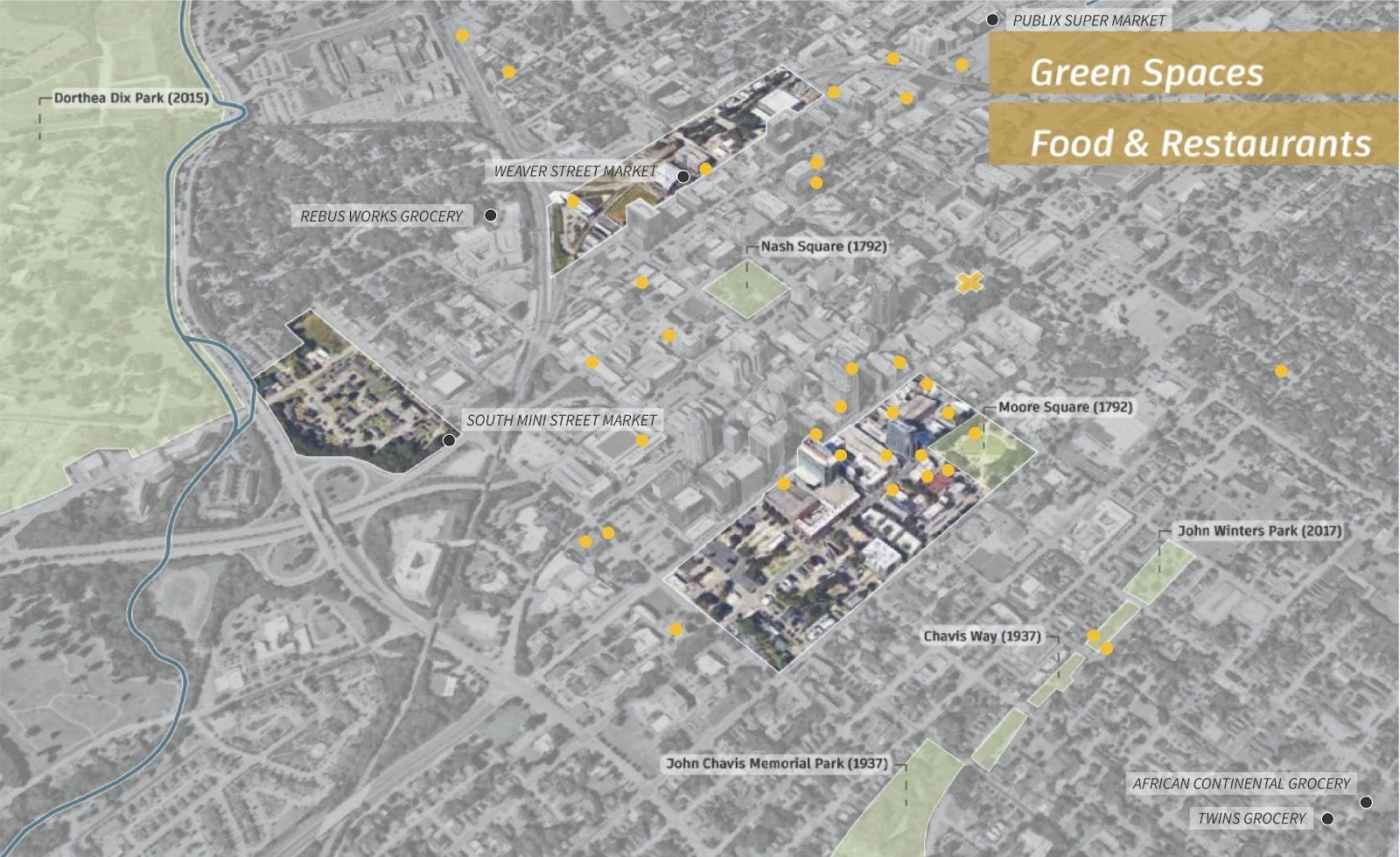
Chloe Craig and Rafael Salas-Garzon’s project, “Extroverted Urbanism,” emphasized enhancing popular destinations rather than overwhelming their existing scale. Neighborhood parks are an appealing amenity for many residents; adorning their boundaries with mid-rise single-stair buildings that contain ground-floor retail would provide space for small businesses, without intruding to the extent of a full shopping center. Family-owned coffee shops and bistro cafes would enhance the experience of the existing green space. By giving residents of the single-stair building easy access to a shared outdoor location, quality of life would improve without requiring expansive backyards for each individual housing unit.
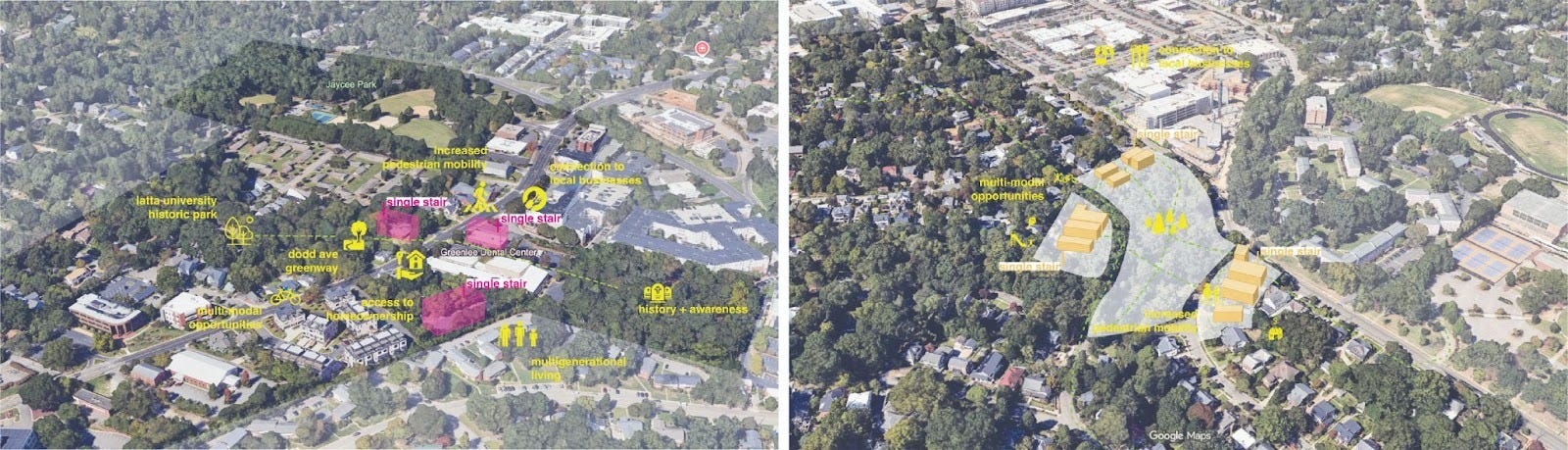
Single-stair housing grows differently than master planned neighborhoods or large-scale apartment complexes. It can emerge incrementally, lot by lot, block by block. It can “grow out of” existing city parcels rather than requiring wide scale demolition and land assembly. As Rafael Salas-Garzon and Chloe Craig observed in their study of Historic Oberlin Village and Forest Park, large buildings and roadway projects can feel like walls: introverted and overwhelming. Single-stair buildings, by contrast, are small enough to integrate into existing contexts, unlocking infill opportunities near parks, corner stores, and neighborhood destinations.
What’s next?
NC State’s single-stair studio has laid out a useful framework for assessing the viability of a site for single-stair development. The foundation for vibrant eco-districts already exists in Raleigh, and single-stair housing provides the missing piece to really make these neighborhoods come to life.
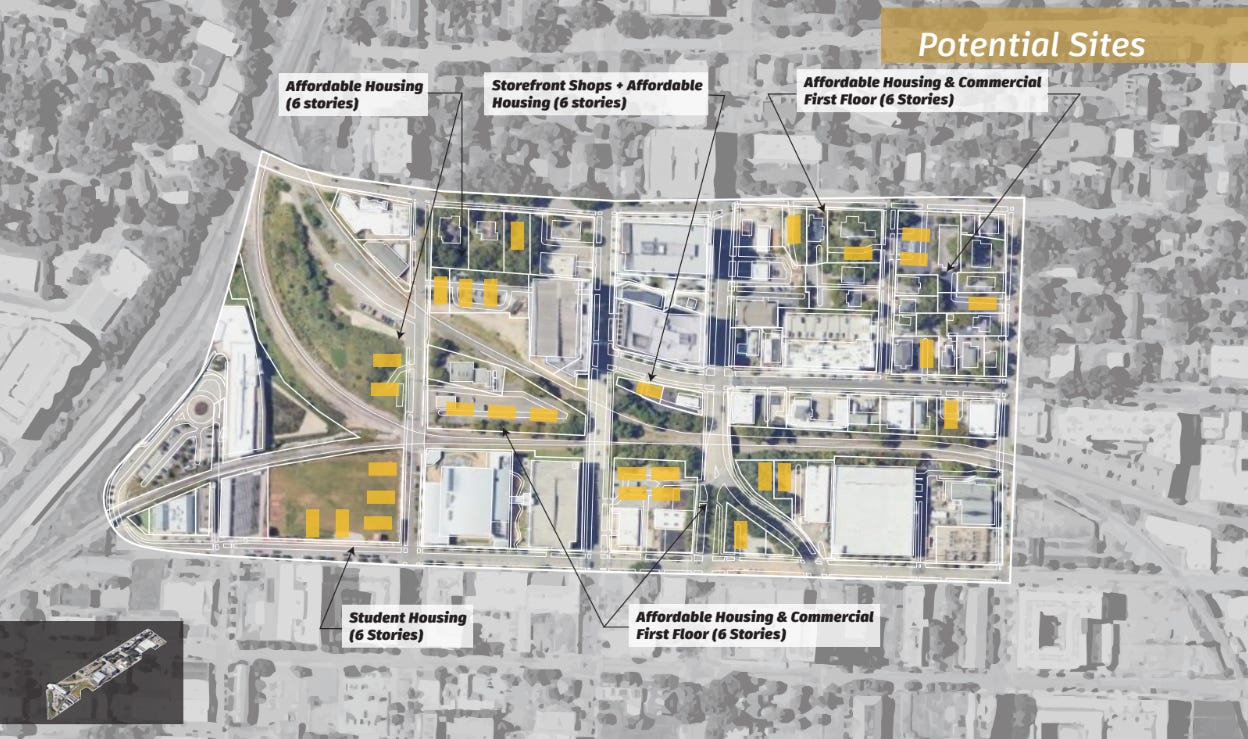
The concept of an “eco-district” provides a useful framework for assessing the vibrancy of a neighborhood. This approach of urban integration respects what is already present, and identifies three key components of success in densification: urban mobility, cultural integration, and connection to green spaces. It asks: what urban features exist here? How can we amplify them? How do we add housing without adding walls? What could match the architectural character of the surrounding neighborhood?
In coming articles, we will explore the student teams’ proposals for single-stair housing within their chosen eco-districts. As the students continue to work on their housing proposals, stay tuned to see what the future of housing looks like in Raleigh, North Carolina!
Julie Powers is a Bachelor of Architecture Student at NC State University, with an LAEP minor.
Additional graphic and illustration support was provided by NC State Undergraduate College of Design in Architecture major Brenna Belcher.


