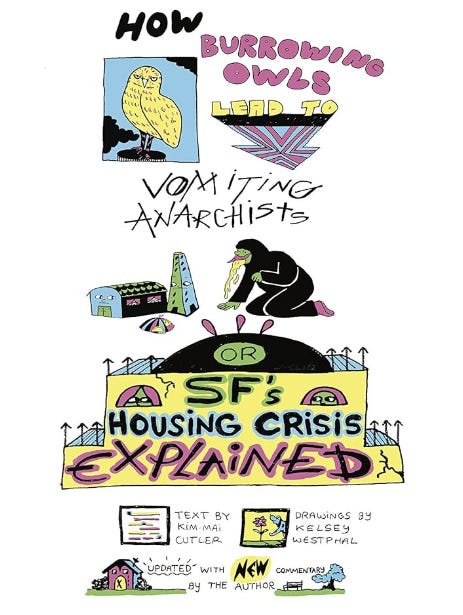
Part flag-planting and part manifesto, it became a seminal work for the YIMBY movement and, in many ways, the first shot in the long war to reclaim American cities for the people.
Today, the piece is especially relevant to North Carolina. Three points stand out in particular:
The article explains San Francisco’s severe housing shortage as the result of decades of restrictive policies and highly organized NIMBY opposition. North Carolina is earlier in that same cycle, but the political dynamics are already visible in local land use debates across the Triangle.
San Francisco’s crisis was driven by a shrinking supply of market-rate housing as rules limited where and how homes could be built. North Carolina is seeing similar constraints emerge through the expansion of HOA-restricted suburbia and zoning protected single-family only neighborhoods, even as demand for housing continues to grow.
Over time, these systems reward homeowners who benefit from limited supply and rising home values. That creates consistent pressure to oppose new housing, especially in established neighborhoods. California took this dynamic to the extreme, but the same pressures are present here, and without clear policy direction North Carolina risks following the same path.
The proper housing policy response in the Triangle today is the same as it was in San Francisco then: pragmatic, frustrated, and relentlessly focused on supply and accountability.
Many of the early wins by YIMBYs were accomplished by simply publishing the exclusionary — and often factually inaccurate — arguments made by NIMBY groups like Livable California during their policy calls. This kind of citizen journalism is only just beginning in the South, and it is long overdue. Sunlight remains the best disinfectant.
For too many North Carolinians under 40, housing is an existential issue.
In North Carolina, the YIMBY movement is growing for the same reasons it did in California: young people face intense housing pressure.
When housing is unstable or out of reach, everything else becomes harder to hold onto. People take longer to settle, stay in shared or temporary situations longer than they planned, or leave places they would have otherwise invested in. Starting a business, changing careers, or putting down roots all begin to feel riskier when the foundation is uncertain.
This is not an abstract policy debate. It is a response to lived experience. More people are recognizing that the rules shaping housing are not neutral, and that changing them is the only way to create choice and real stability.
NIMBYism is backed by trillions of dollars in U.S. home equity and by non-representative groups of homeowners who are deeply invested in protecting scarcity. But that advantage is no match for younger North Carolinians who are trying to build stable lives in the places they care about. They are living with the consequences of this system every day, and they are not going to accept it indefinitely. I choose to bet on those young people.
Kim-Mai Cutler fired the first shot in this war twelve years ago today.
Her piece starts in the middle of the chaos, but stay with it. Cutler connects the protests, the politics, and the underlying housing shortage into a clear explanation of how a crisis like this gets built over time.
Read it with North Carolina in mind.
How Burrowing Owls Lead To Vomiting Anarchists (Or SF’s Housing Crisis Explained)
The Santa Clara Valley was some of the most valuable agricultural land in the entire world, but it was paved over to create today’s Silicon Valley. This was simply the result of bad planning and layers of leadership failure — nobody thinks farms literally needed to be destroyed to create the technology industry’s success.
Today, the tech industry is apparently on track to destroy one of the world’s most valuable cultural treasures, San Francisco, by pushing out the diverse people who have helped create it. At least that’s the story you’ve read in hundreds of articles lately.
It doesn’t have to be this way. But everyone who lives in the Bay Area today needs to accept responsibility for making changes where they live so that everyone who wants to be here, can.
The alternative — inaction and self-absorption — very well could create the cynical elite paradise and middle-class dystopia that many fear. I’ve spent time looking into the city’s historical housing and development policies. With the protests escalating again, I am pretty tired of seeing the city’s young and disenfranchised fight each other amid an extreme housing shortage created by 30 to 40 years of NIMBYism (or “Not-In-My-Backyard-ism”) from the old wealth of the city and down from the peninsula suburbs.
Here is a very long explainer. Sorry, this isn’t a shorter post or that I didn’t break it into 20 pieces. If you’re wondering why people are protesting you, how we got to this housing crisis, why rent control exists or why tech is even shifting to San Francisco in the first place, this is meant to provide some common points of understanding.
This is a complex problem, and I’m not going to distill it into young, rich tech douchebags-versus-helpless old ladies facing eviction. There are many other places where you can read that story.
Homeowners have a strong economic incentive to restrict supply because it supports price appreciation of their own homes. It’s understandable. Many of them have put the bulk of their net worth into their homes and they don’t want to lose that. So they engage in NIMBYism under the name of preservationism or environmentalism, even though denying in-fill development here creates pressures for sprawl elsewhere. They do this through hundreds of politically powerful neighborhood groups throughout San Francisco like the Telegraph Hill Dwellers.
Then the rent-controlled tenants care far more about eviction protections than increasing supply. That’s because their most vulnerable constituents are paying rents that are so far below market-rate, that only an ungodly amount of construction could possibly help them. Plus, that construction wouldn’t happen fast enough — especially for elderly tenants.
So we’re looking at as much as 80 percent of the city that isn’t naturally oriented to add to the housing stock.
Oh, and tech? The industry is about 8 percent of San Francisco’s workforce.
Then if you look at the cities down on the peninsula and in the traditional heart of Silicon Valley, where home-ownership rates are higher, it’s even worse.
So the wealthy voting classes of the peninsula are also strangling themselves of housing too. The median rent in Mountain View is $2,700 compared to $3,400 in San Francisco, according to Zillow. Once you factor in the cost of owning a car — estimated at slightly more than $9,000 a year by the AAA — it’s not that much cheaper.
So one contributor to the tech industry’s spread into San Francisco is that the peninsula cities are more than happy to vote for jobs, just not homes.
2) Why is the tech industry migrating to cities anyway?
This is a demographic shift that is much larger than the technology industry itself — although there are some tech-specific reasons that have fueled a migration north from the historic heart of Silicon Valley over the last 10 years.
This is what urbanist Alan Ehrenhalt calls “The Great Inversion,” a major shift where cities and suburbs have traded places over the last 30 to 40 years. As people marry later and employment becomes more temporal, young adults and affluent retirees are moving into the urban core, while immigrants and the less affluent are moving out.
San Francisco’s population hit a trough around 1980, after steadily declining since the 1950s as the city’s socially conservative white and Irish-Catholic population left for the suburbs. Into the vacuum of relatively cheaper rents they left behind, came the misfits, hippies and immigrants that fomented so many of San Francisco’s beautifully weird cultural and sexual revolutions.
But that out-migration reversed around 1980, and the city’s population has been steadily rising for the last 30 years.
This is a phenomenon that’s happening to cities all over the United States.
It’s happening in Seattle, Atlanta, New York City, Boston and Washington. D.C.: