

Back in March, I had the opportunity to sit down with Melanie Rausch, a Transit Planning Manager for the City of Raleigh. Melanie has been with the City for four years, where she’s worked on Raleigh’s burgeoning Bus Rapid Transit (BRT) program. To kick off our discussion, I wanted to know more about the projects she worked on before joining the BRT team:
“I’m proud of getting our real time information into the transit app. I also started the effort to get our real time information into Google Maps. I pushed to get that real time information out there. So many people have smartphones now, and being able to look at your smartphone and see where your bus is or when it will arrive provides a sense of relief and comfort that improves the experience and encourages using public transit.”
Her team is currently guiding Raleigh’s BRT project through its first phase of construction along the New Bern Avenue corridor. The BRT program will connect Cary, Garner, North Raleigh, and East Raleigh through four different routes. I used our discussion to learn more about how the City pays for transportation projects, why BRT is one of the most exciting new developments happening in the City of Oaks, and how our transit systems are linked to virtually every aspect of city planning.
This piece was written by Elijah Geist, a CITYBUILDER student fellow. Each semester, CITYBUILDER provides fellowship opportunities for aspiring student urbanists in the Triangle.
Our first topic of discussion was the Wake Transit Plan, which was originally adopted in 2016 and amended in 2021 and 2025. I asked Melanie about the significance of the plan and what it means for her department’s work:
“The Wake Transit Plan is significant for a lot of reasons. Mostly because the 2016 plan introduced the ½ cent sales tax dedicated to increasing funding efforts for public transportation. When it comes to public transportation projects, some transit agencies receive more funding from their state than others, so having that ½ cent sales tax helps Wake County supplement funding.”
“From a more public-facing perspective, prior to the Wake Transit Plan, Raleigh only had three high frequency bus routes, which means there were only three bus routes with a frequency of 15 minutes or less. Now, we have 11 routes that fall within that threshold. The Wake County Transit Plan has improved results through collective action on a county and local municipal level. I always recommend looking at the National Transit Database (NTD) if you’re someone interested in understanding the funding behind transportation planning.”
The original transit plan was developed with 4 principles in mind: 1) Connect the Region, 2) Connect All Wake County Communities, 3) Create Frequent, Reliable, Urban Mobility and 4) Enhance Access to Transit. At CITYBUILDER, we focus heavily on land use, so I wanted to know what implications these transit principles have for land use in the Triangle Area:
“There is this author I really enjoy, Jarrett Walker. He wrote a book that I’ve read multiple times. It’s called Human Transit, and the second edition specifically highlights the intersection between transportation planning and land use planning, and how policy decisions affect both. It explains how transit, housing, and land use coincide in more ways than one. The way that location affects costs can encourage important destinations to be spread out. It is not intentional — it’s simply a side effect of current development practices.”
The team behind the BRT project is working hard to ensure that transportation and land use are not siloed. Instead, transit staff are taking a more holistic approach to project development: focusing on making public transit easier to access, more reliable, safer, and more convenient than ever before. I asked Melanie what makes BRT so special compared to other transit projects:
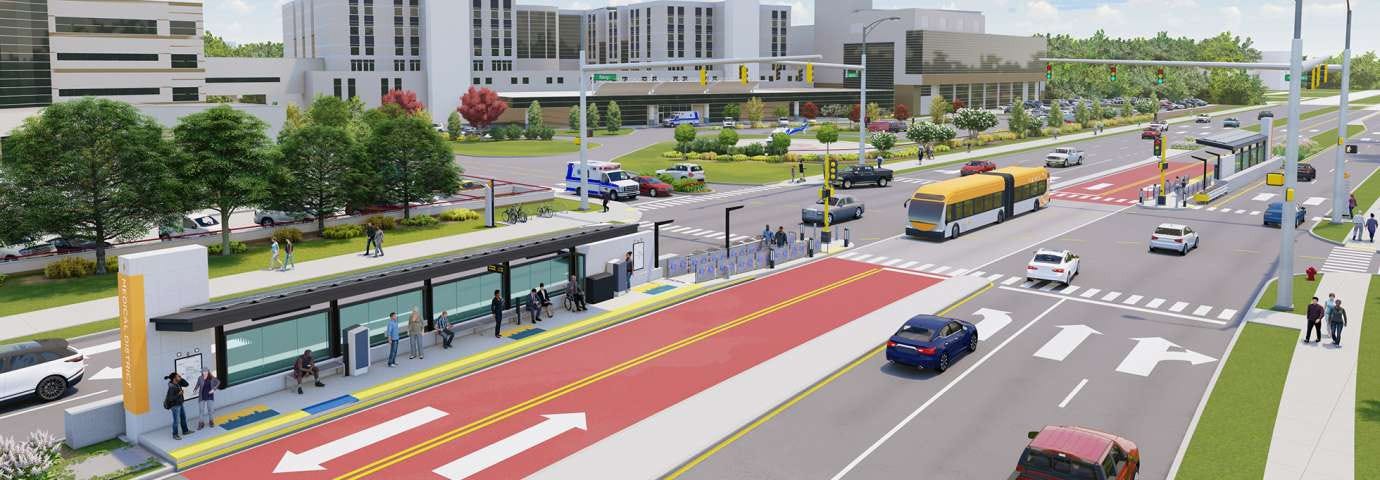
“BRT is taking routes that have been identified as having high demand and high transit propensity, and we’re essentially trying to “beef it up”. We’re trying to build stations that provide a similar service to rail, but without all of the associated costs.”
“These include things like level boarding — which speeds up the boarding process and makes it more accessible — as well as transit signal priority (TSP), queue-jumps, dedicated bus lanes along sections of the corridors, 10-minute frequency, increased span of service, stops at every station, and the addition and improvement of pedestrian facilities.”
You can read more about transit propensity and how it is used to identify communities with mobility needs here.
Let’s break down the features that Melanie mentioned: Queue jumps allow buses to skip through traffic by optimizing when the BRT loads passengers or moves through an intersection. Transit Signal Priority (TSP) either provides longer green lights or shorter red lights based on BRT movement. When a transit service like BRT receives signal priority through TSP or queue-jumps, this is called transit preferential treatment.
In addition to preferential treatment, BRT will provide sheltered stations with ample seating and lighting, fully integrated real-time arrival displays, ticket vending machines, public art installations, and improved pedestrian and bicycle infrastructure in the surrounding areas.
Reducing road congestion is a common priority for local governments. In American cities, almost all trips (92%) take place by car. Because of this, many residents have trouble seeing the value in public transportation investments, especially residents who don’t use public transit themselves. I asked Melanie how she felt about this reasoning:
“You know how the phrase goes, “build it and they will come.” That same concept can apply to investing in public transit. The more time and resources we spend investing in our transportation networks, the more likely people are to use them. When more people use public transit, the number of cars on the road decreases. With the BRT program, we are trying to make a viable transportation alternative in the Triangle.”
There’s also a logical reason for residents concerned about traffic to support public transit. The concept of induced demand explains that when the number of lanes on a road is increased, an equally proportionate number of vehicles will end up using that road in the future. Basically, more people will start driving, or they’ll drive more, so traffic won’t actually decrease. You can’t just build your way out of bad traffic, you have to find alternatives that actually incentivize use by making non-car travel easier, safer, and more convenient.
Throughout my life, I’ve lived in places with limited access to public transit. I grew up in a low-income household that was less concerned with pedestrian infrastructure and more concerned with paying the bills. I never really gave it much thought until I went to NC State and got my first exposure to density and walkability. It wasn’t until that experience that I realized pedestrian infrastructure, public transit, and walkability can help with “paying the bills” — driving less puts gas money back into pockets and saves us time along the way. I think this is the case for most people in the Triangle. I asked Melanie if she relates to some of the apprehension people feel towards “new” transit projects:
“I know it can feel a bit strange or intimidating to invest in something you haven’t experienced before. Trying to assess value can be even more challenging. It doesn’t help that narrative building has been working against public transportation in a lot of ways. We’re trying to flip that perception.”
Raleigh is joining a number of cities in the Southeast that have BRT: In Richmond, VA, they have PULSE BRT, and in Atlanta, GA, they have MARTA BRT. Within the last few years, Richmond approved the Sauer Center — a 37-acre mixed-use residential development that will include diverse housing options, retail, public space, and other amenities, all built along the middle portion of the city’s BRT line. In September of 2025, the City of Atlanta began accepting proposals for constructing an 11-acre residential development along the MARTA BRT corridor.
I wondered if Melanie envisions Raleigh’s BRT encouraging similar large-scale investment along the underserved corridors where it’s currently being constructed:
“Absolutely, and that’s the goal. The City’s Comprehensive Plan identifies Frequent Transit Corridors and encourages density along those routes. That’s part of the BRT’s goal, to attract investment in these communities.”
“Businesses feed off of each other. Hillsborough Street is a corridor in Raleigh that radiates from Downtown without becoming a challenging environment for pedestrians. It maintains a mix of land use types and diverse transportation options. BRT and similar projects aim to provide other corridors with the same opportunity to become a destination.”
To close out our conversation, I wanted to know if transportation networks had impacted Melanie’s life in a meaningful or memorable way:
“Definitely. I have always centered my housing choices around transportation. My parents believed in living close to where you work, so we lived in areas with lots of employment opportunities. Today, I always try to live within a couple miles of where I work. I recently moved and I made sure I still lived near a 15-minute route connected to where a lot of my friends live.”
Build public transit, and they will come.
Be sure to check out the most recent updates on Raleigh’s Bus Rapid Transit here.
This piece was written by Elijah Geist, a CITYBUILDER student fellow and current graduate student at the UNC Department of City and Regional Planning.
