
The Best Urban Planners Are Video Game Developers
Video games design cities for walkable exploration instead of parking

Over the last decade, 3D open-world games have exploded in popularity, and breathtaking new graphics are revolutionizing what customers expect from video game maps. Designers have had to be intentional and detailed in their creations to keep up with demand.
What makes a video game environment interesting? What makes some of the best-rated game franchises in recent memory — Grand Theft Auto, The Last of Us, Fallout — so beautiful and endlessly fascinating to explore?
It may be unexpected, but video game designers are some of the most daring urbanists of our time.
Grand Theft Auto V might be the best example of a real-world city transported into the virtual realm. Set in the fictional city of Los Santos, the open-world playground of GTA V mirrors the landmarks, cityscape, topography, and flora of Los Angeles, with one crucial difference: a notable lack of parking lots. It seems odd for a game centered around stealing cars and embarking on auto-dependent missions, but the denizens of Los Santos are relegated to street parking when dropping off their carriages.

Looking at these side-by-side pictures of Los Santos and its real-life equivalent, the intentional design choices become readily apparent: Six-lane highways are cut in favor of more greenery and gently sloping, winding roads.
The thrill of joyrides in GTA V is hardly diminished by the lack of huge asphalt deserts in which to deposit a vehicle. On the contrary, haphazard parallel parking jobs that let players leap to the next car keep them engaged in the lively streetscape of Los Santos.

Even the single-family home neighborhood of “Vinewood Hills” is notable for its lack of cul-de-sacs and dead ends. The real-life Hollywood Hills wouldn’t provide the same degree of immersion if players were constantly forced to reverse themselves at the end of a leisurely ride around the neighborhood.

Fallout 4, a post-apocalyptic role-playing game, takes place in the radioactive ruins of twenty-third century Boston. A focal point of the story is “Diamond City”, a development in what was once Fenway Park. Some Bostonians like to compare the accuracy of various landmarks, but they’d be forgiven for missing the half-dozen parking lots and garages immediately adjacent to Fenway that, in the game, have been converted to other buildings to match the environment. Consider the satellite view above. How exciting would the game be if the adventure were interrupted by all those parking areas? Even after the apocalypse, nothing is more depressing than walking through a parking lot.

Despite the ruined roads of Fallout’s Boston being littered with abandoned automobiles, the streets are tight and the alleys narrow, encouraging the player to keep pushing and exploring.
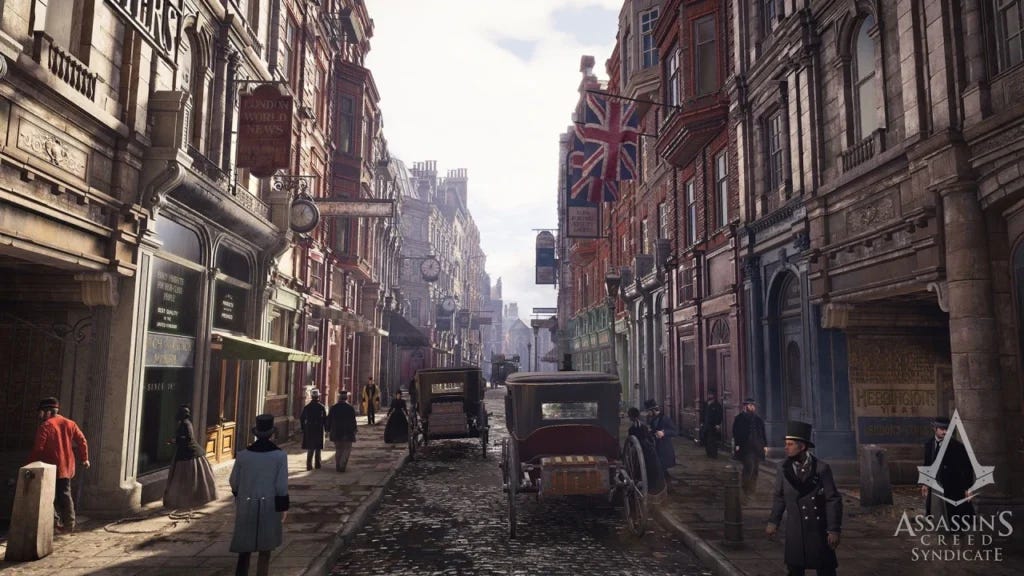
Video game designers take care to build an environment that keeps players engaged and interested. When they borrow real-life elements to capture the essence of certain cities, their changes are deliberate: swapping parking lots and decks for buildings, narrowing roads, and drawing connected, walkable avenues that beckon the player toward adventure.
If gamers won’t settle for anything less, why should we?
Zoe Tishaev is a graduate with distinction from Duke University, where she studied the creation of community and connection through architecture and placemaking. She holds a B.A. in Political Science and minors in sociology and economics.


