
These Rules Are Shaping Raleigh's Skyline
The city's Unified Development Ordinance is guiding its present and future

To understand Raleigh’s Unified Development Ordinance (UDO) and how it has shaped the City of Oaks, we must go back to origins of the capital itself. In 1792, when Raleigh was first chartered, the City Code was created. For over 200 years, the City Code has encompassed all of Raleigh’s municipal laws. After some modernization, these codes were incorporated into Raleigh’s Municode library, where they reside today.
Among the City Code is the zoning code, which the City of Raleigh defines as the “process of partitioning a city, town, or borough into zones reserved for different purposes (such as residence or business) and is intended to promote an orderly pattern of development.” Essentially, zoning aims to ensure that the city’s built environment and land uses are compatible across its many different areas.
This piece was written by Elijah Geist, a CITYBUILDER student fellow. Each semester, CITYBUILDER provides fellowship opportunities for aspiring student urbanists in the Triangle.
The first instance of formal “zoning” in America was introduced in New York City. Written in response to concerns about overdevelopment, the Big Apple’s Comprehensive Zoning Resolution was passed into law on July 25th, 1916. The code divided the city into zones based on primary activities and included height and setback standards. Over the next few years, the City of Raleigh and its surrounding municipalities began introducing similar zoning codes in their jurisdictions.
Raleigh’s Sordid Zoning Past
Raleigh, like every other municipality in the U.S., has an unsavory history with zoning. While the tool is often touted as a means to keep a city safer, cleaner, or more economically efficient, it has frequently been employed as a means to further sinister goals. Over the past hundred years, zoning has separated people far more often than land. This usually took the form of restrictive and racially motivated covenants.

Initially, Raleigh’s zoning focused on creating separation, both of people and of differing land uses. This continued into the post-WWII era, which saw a spike in suburban sprawl driven by white flight. As a result, the city’s code increasingly prioritized the development of single-family housing, eventually prohibiting most multifamily developments. Prior to recent zoning reforms, over 50% of Raleigh prohibited the development of multifamily units. Text changes passed in 2021 legalized multiple forms of missing middle housing throughout the city, taking the first steps towards undoing the zoning that long separated the city.
How the UDO Interacts With the Comprehensive Plan
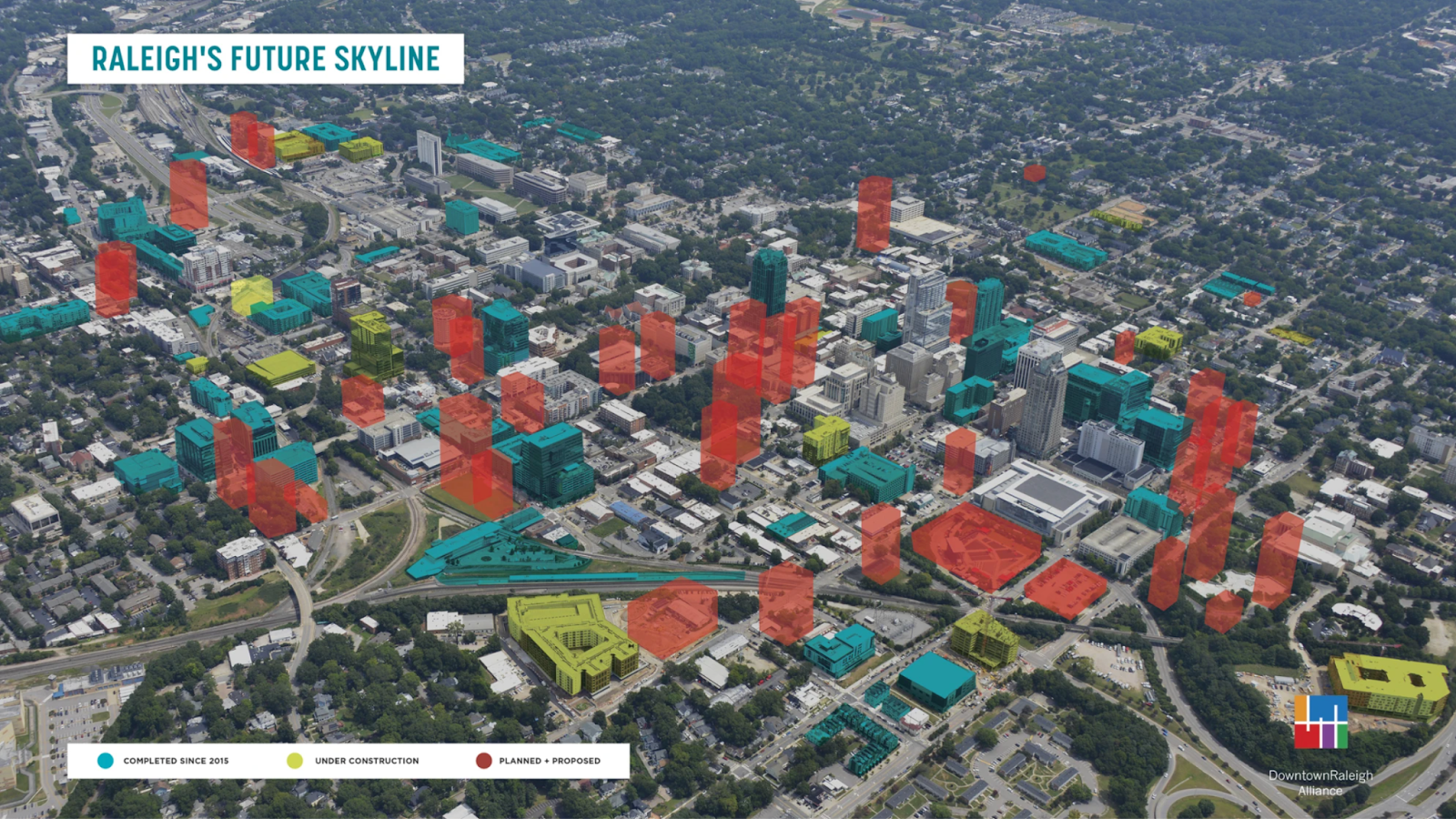
To expedite the review and development process, most cities in the U.S. have adopted some version of a UDO. Raleigh began developing theirs in 2010, in response to the City’s adoption of its 2030 Comprehensive Plan. In short, a Comprehensive Plan serves as a non-binding document that outlines the development goals of a municipality. Raleigh’s previous Comprehensive Plan, which was adopted in 1989, emphasized suburban development and auto-centric thoroughfares. In comparison, Raleigh’s 2030 Comprehensive Plan stresses the importance of walkability, density, and human-scale public spaces.
Raleigh officially adopted the current UDO in 2013 as text change TC-3-13, and it became fully effective throughout the planning jurisdiction in 2016. The UDO consolidates all development regulations into a single application, covering topics from zoning and land use regulations to design and preservation standards.
The Structure of Raleigh’s UDO
The UDO consists of twelve chapters, each covering a part of the development and review process:
Introductory Provisions
Residential Districts
This chapter guides the protection of existing residential neighborhoods, as well as the planned construction of future developments. This section also emphasizes the compatibility of uses, noting that incompatible uses are discouraged by district provisions.
Mixed Use Districts
This chapter details how uses can be combined within regulation and outlines where certain combined uses should go to best adhere to the development context.
Special Districts
This chapter outlines Special Districts within the UDO, which are designed for multiple uses and can provide unique guidance for certain developments. For example, the Campus (CMP) Special District seeks to help colleges and universities grow while shielding the surrounding communities from major development.
Overlay Districts
This chapter intends to “apply regulations that achieve a specific purpose to a targeted area.” Sometimes, certain zoning regulations are superseded by overlay districts. For example, the Transit Overlay District (TOD) allows for height bonuses for some developments along major transit corridors.
Use Regulations
This chapter includes details on specific uses and how they are regulated within the planning jurisdiction.
General Development Standards
This chapter guides the development standards of parking, lighting, signs, landscaping, etc.
Subdivision & Site Plan Standards
This chapter details how site plans must meet certain standards and be fully approved by the City before any construction can commence. It covers a wide range of administrative approvals.
Natural Resource Protection
This chapter explores development standards in the context of tree conservation, stormwater management, watersheds, flood hazards, and erosion.
Administration
Development plans require approval and enforcement when standards are violated. This chapter details how plans are reviewed, corrected, and approved.
Building & Housing Code
Structures need to be safe, and to some degree, standardized. The Building & Housing Code chapter outlines clear building code standards to ensure that codes are followed exactly.
Definitions
This contains definitions of relevant terms and phrases used throughout the UDO.
Raleigh’s UDO Reforms
Recently, Raleigh has taken an important turn in its land use practices by choosing to prioritize the development of denser and more diverse housing options. One of the key principles in the current UDO is its promise to “provide neighborhoods with a variety of housing types to serve the needs of the population.” As a city with one of the consistently high rates of population growth in North Carolina, Raleigh is on the precipice of becoming one of the nation’s major municipalities. Supporting more permissive zoning regulations will ensure that Raleigh can keep up with a whirlwind of population growth and economic development.
One of the ways that the current UDO has allowed Raleigh to grow sustainably is through text changes, such as TC-5-20 (2021) and TC-20-21 (2022). These changes were made to enable the construction of more diverse housing types, aimed at addressing the “missing middle” problem in Raleigh. By decreasing minimum lot sizes, allowing the construction of tiny houses, permitting flag lots, and more, these UDO reforms have helped the City of Raleigh address a rampant housing shortage. Through these text changes, the City has been able to add nearly 5,000 mid-sized housing units to its stock.
Understanding the UDO empowers residents and policymakers alike to participate meaningfully in shaping growth and future development. The UDO is a tool, and the citizenry of Raleigh should know how to use it.
All of the information in this article was gathered from the City of Raleigh Unified Development Ordinance, the Form-Based Codes Institute article “Raleigh Unified Development Ordinance”, and the American Planning Association’s “Planning History Timeline”.
Elijah Geist is a passionate Raleigh citizen and Graduate Student in UNC-Chapel Hill’s Department of City and Regional Planning. He is graduating in May of 2026 with his Masters Degree in City and Regional Planning with a Concentration in Transportation. He enjoys researching active transportation and pedestrian connectivity.


