

Mobility isn’t a foreign concept to me. Growing up, I attended 10 schools in 13 years, following my peripatetic academic mother to opportunities at Harvard, UNC, and Michigan. I’ve always believed that the constant change has both conditioned me to thrive in new situations and left me hunting for tools of rootedness for my family.
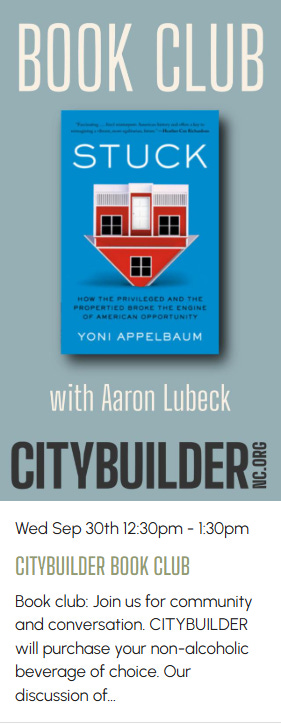
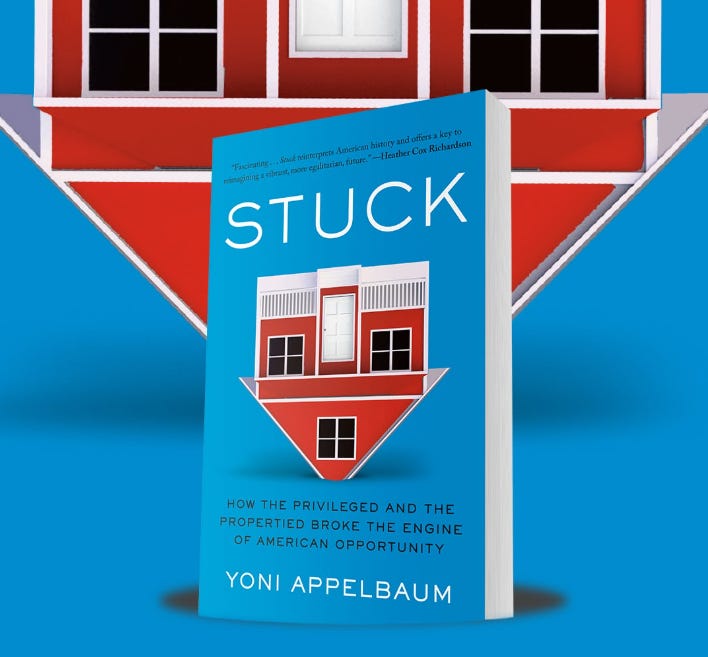
Yoni Appelbaum is a senior editor for The Atlantic, and author of the recently published book Stuck: How the Privileged and the Propertied Broke the Engine of American Opportunity. I will be leading a book club conversation about his thoughts in Raleigh next week. I’m a big fan of Appelbaum and this book, and below I review it while also identifying two contrarian views of his that stood out to me.
First, Appelbaum spends ample time critiquing Jane Jacobs with a relatively common critique that, while she is a patron saint of urbanism, she also had a troubling streak of Nimbyism that is worth understanding and unpacking. I’m on record as a committed fan of Jacobs’ work and have published the Jacobs column at Southern Urbanism since its founding. While I believe she is the origin of the New Urbanism and the first major objector to authoritarian American planning, I agree with Appelbaum that some of her strategies in defending Greenwich Village are also the germ seed of American Nimbyism. More on that below.
Secondly, Appelbaum flips the idea that rootedness leads to openness. This was almost shocking to read, as I, like most of you, believe that deep roots in a community (often created by the longevity of its residents) create bonds that strengthen relationships and make it more welcoming to outsiders. Appelbaum uses storytelling to show that this last point is not true and, in fact, the opposite may be true: nomadic people tend to be more welcoming and open, while people who stay and don’t move tend to be more closed, pessimistic, xenophobic, and resistant to others.
In this light, he argues that Americans’ mobility used to be unrivaled in the world, and this ability to perpetually up and move was the engine that drove our great experiment.
The idea that people should be able to choose their own communities—instead of being stuck where they are born—is a distinctly American innovation. It is the foundation for the country’s prosperity and democracy, and it just may be America’s most profound contribution to the world.
More importantly, Appelbaum points out that our mobility has radically declined over the last half century, and this is concerning. He links mobility to the American Dream, and mobility’s decline is also seeing correlating declines in happiness, civic participation, entrepreneurship, and cultural cohesion. And he rightly identifies progressive politics (he himself is often defined as “center-left”) as the problem, not because it is wrong, per se, as much as it is hypocritical:
The exclusion that has left so many Americans feeling trapped and hopeless traces back, instead, to the self-serving actions of a privileged group who say that inclusion, diversity, and social equality are among their highest values.
The American virtue of choice has been legislated out of commission. Appelbaum’s book concludes this harsh fact: “Opposition to mobility appears concentrated in progressive jurisdictions.”
How damning.
HOUSES AS TOOLS, NOT INVESTMENTS
Today, most Americans treat their primary home as an investment vehicle and, secondarily, as a place to raise their family. This has only been the case recently, as a consequence of inflationary monetary policy (among other issues), which encourages investment in appreciating assets relative to the declining value of cash. If homes were depreciating assets, which they had been for centuries, most of the shenanigans around Nimbyism would never arise. Appelbaum describes what this would look like by using the analogy of how we treat our iPhones:
Americans once tended to look at houses the way Americans today look at cars or iPhones. One decade’s prohibitive luxury was the next affordable convenience, and the third’s absolute necessity. A home was less a long-term investment—most people leased—than a consumer good to be enjoyed until the next model came within reach.
Also, since the 1960s, lawyers, politicians, and neighborhood advocates have specialized in bureaucratic lawfare that hijacks planning processes to prevent competition, keep outsiders out, and maximize personal asset value and appreciation rates for their own benefit. Often presented under a banner of “community engagement”, implying the wider community supports the behavior that might not exist, Appelbaum argues that this lawfare functions as the antithesis of equity, largely to rig the system for the elites at the expense of the remainder: “Professionals leverage their training and expertise to mount a challenge to the planning process, a form of bureaucratic warfare unavailable to the great majority of Americans.”
A nation that had grown diverse and prosperous by allowing people to choose their communities would instead empower communities to choose their people
Appelbaum takes the gloves off on Jacobs here—where most urbanists treat her (and her writing) as a sacred cow, he accuses her of starting the nationwide process of exclusionary neighborhood planning (“neighborhoodism”) which dominates land use conversations to this day. I’ve personally witnessed planners go into neighborhoods and tell them “this is your neighborhood” and “you get to decide what goes here.” In a world of private property and public realm, these assertions are neither accurate nor helpful, and I’ve seen it not end well, but it doesn’t stop them from selling the story:
To stave off change, Jacobs and her allies asserted a proprietary right to control their neighborhood. It belonged, they argued, to those who were already there, and it should be up to them to decide who would get to join them. Over the decades that followed, the idea would take hold throughout the United States; a nation that had grown diverse and prosperous by allowing people to choose their communities would instead empower communities to choose their people.
While I might give Jacobs a small pass for staving off assaults from government planners rather than organic incremental development (it was the wrecking ball of a drunk-on-power Robert Moses she was up against), and that Nimbys citing Jane Jacobs often misread her and do so in bad faith, I do agree with Appelbaum that the modern neighborhood Nimby “Culture of No” started here. He argues, “In practice, the new processes turned out to be profoundly anti-democratic, allowing affluent communities to exclude new residents.” These practices were, and remain, profoundly unjust.
WE ARE MOBILITY, MOBILITY IS US
I spend a lot of time thinking about rootedness, a key component of placemaking and new urbanism. Conventional wisdom says that “moving” (or, in the negative, “displacement”) makes us worse, but Appelbaum flips this to suggest that “rootedness” is also synonymous with “being stuck”. It’s not always positive or voluntary. And he points out that this enthusiasm and optimism that is relatively unique to being an American is tied to our ability to move, try new things, experiment, and execute:
The key to vibrant communities, it turns out, is the exercise of choice. Left to their own devices, most people will stick to ingrained habits, to familiar circles of friends, to accustomed places. When people move from one community to another, though, they leave behind their old job, connections, and identity and seek out new ones. They force themselves to go meet their neighbors or to show up at a new church on Sunday despite the awkwardness. American individualism didn’t mean that people were disconnected from each other; it meant that they constructed their own individual identity by actively choosing the communities to which they would belong.
In other words, mobility and abundance thinking correlate. In Europe, immobile lifestyles “had taught them that admitting new members left a community with less to go around, so they treated outsiders with suspicion and hostility.” In America the polar opposite was true: “People who have recently changed residence report experiencing more supportive relationships and feeling more optimistic, having a greater sense of purpose, and increased self-respect. Those who want to move and cannot, by contrast, become more cynical and less satisfied with their lives.”
ZONING MAKES US IMMOBILE, POORER, and LESS HAPPY
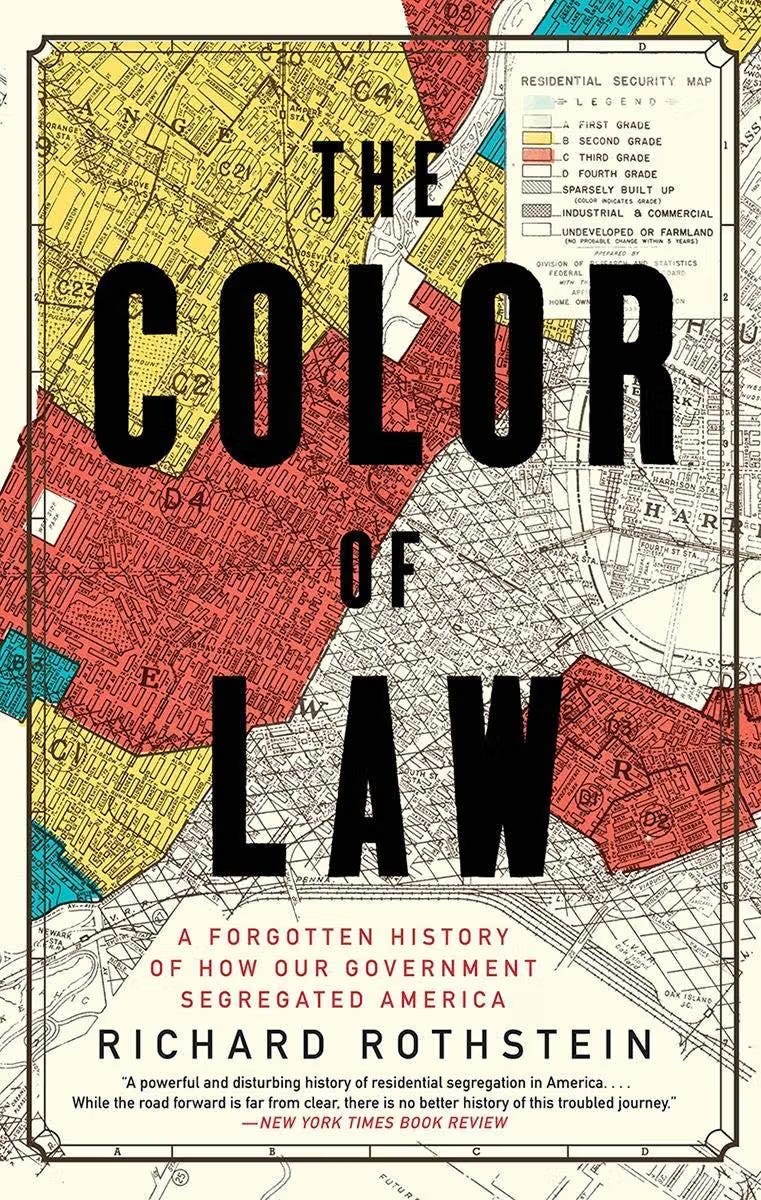
Anybody who reads my writing knows I’m a persistent critic of both American zoning and the American planning institutions that create and enforce its standards. It’s because I find both un-American. If you’re skeptical of that thesis, I encourage you to read The Color of Law, which will disabuse you of any doubt.
Like Richard Rothstein’s book, Appelbaum goes to the historical archives to prove that not only is zoning exclusionary (and often racist) today, but that it was always exclusionary and racist and founded to be precisely exclusionary and racist:
Zoning may have been adopted by well-meaning urban planners, but the process began in 1885 in Modesto, in California, where bigoted local officials were looking for a tool to push out Chinese residents; the federal courts would not allow them to segregate their city by race. They hit on a workaround: confining laundries—whose proprietors were overwhelmingly Chinese and generally lived in their shops—to the city’s Chinatown. Over the ensuing decades, other cities embraced this approach, discovering that segregating land by its uses and the size of the buildings it could hold was a potent means of segregating populations by race, ethnicity, and income.
Worse, a century on, legacy institutions have captured zoning as a tool to prevent newness, change, innovation, immigration, and growth.
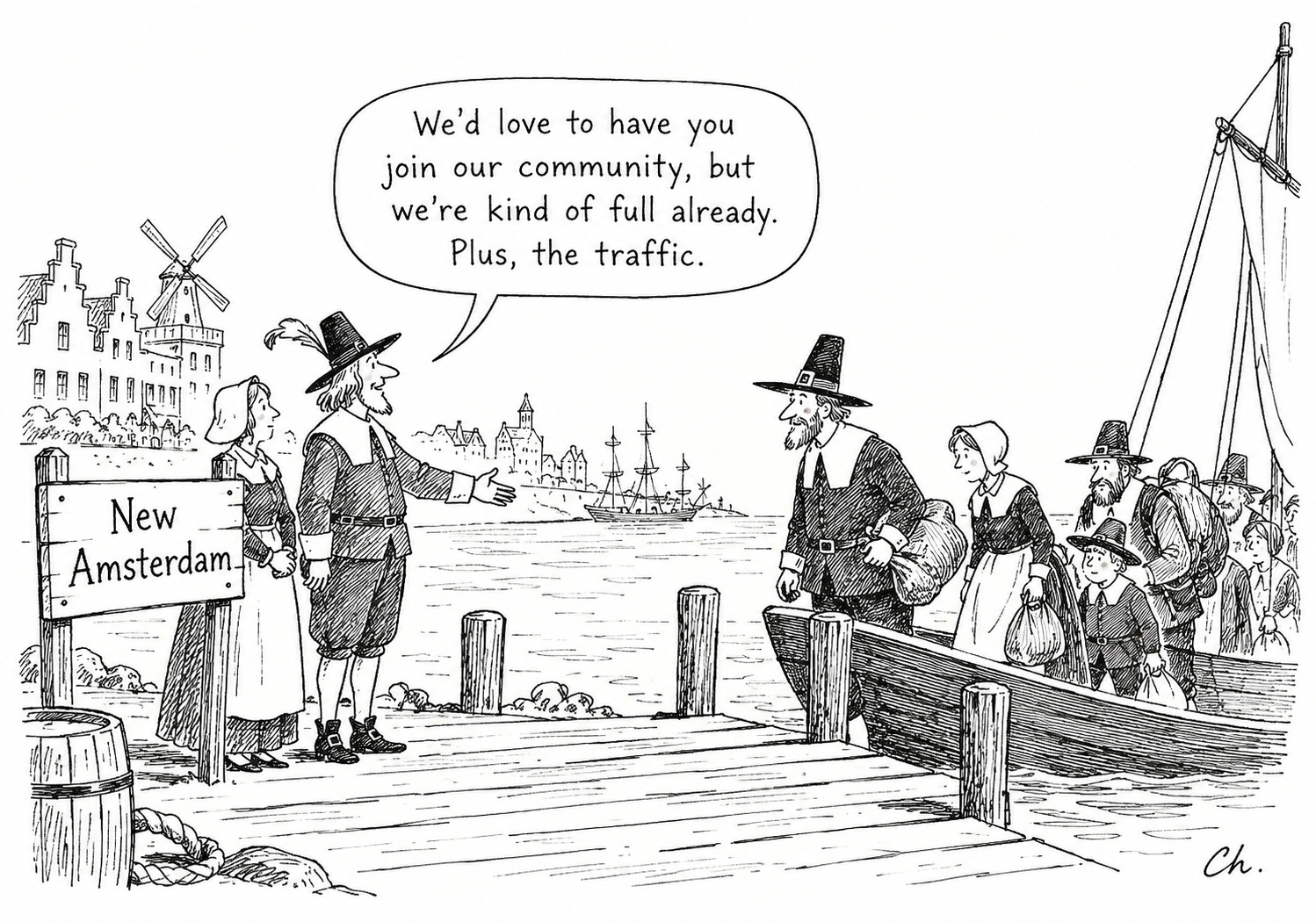
Whatever its theoretical aspirations, in practice, progressivism has produced a potent strain of Nimbyism, a defense of communities in their current form against those who might wish to join them. Mobility is what made this country prosperous and pluralistic, diverse and dynamic. Now progressives are destroying the very force that produced the values they claim to cherish.
Discouraging mobility is the Achilles’ Heel of Progressivism in two ways. First, Nimbyism is proving to be an electoral loser, year after year. As the Democratic Party continues to flirt with the ideology, old-school party members lose interest, and moderates drift. Second, Nimbyism is proving to be electoral suicide at the national scale, as Americans are leaving progressive strongholds for red states, which tend to be more welcoming and supportive of traditional mobile lifestyles.
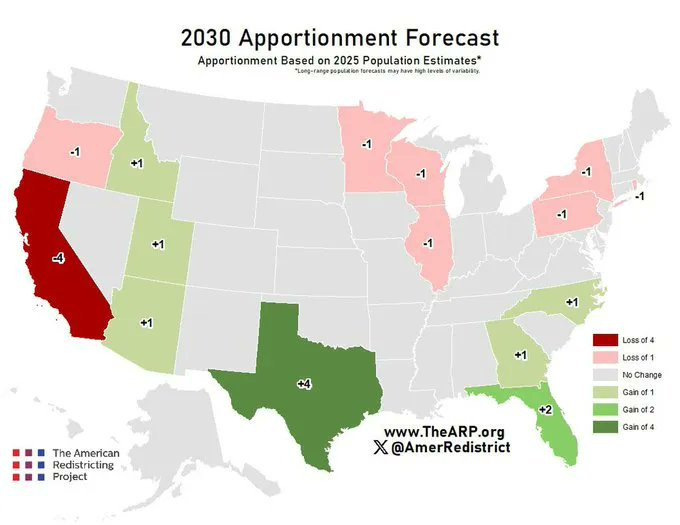
Progressives need to change this quickly, before national elections become completely unwinnable for a generation. To me, the path to national relevancy goes through housing. It’s getting Americans moving again. It’s letting families flourish and live in the most productive metros in the land. It’s celebrating that vibrancy, that optimism, the thrill of packing up and moving cross-country, the euphoria that comes with trying to start a business, a family, a civic institution. I can’t remember the last time the party exuded that kind of vibe.
And it’s because we’re stuck.
Far fewer Americans move every year than at any time in history. And, unlike a century ago, the ones moving are the ones who don’t need to. Appelbaum points out that “it was the working class who traditionally had the most to gain from moving, whereas today the gains are largely available only to the affluent.”
He concludes with three solutions—consistency, tolerance, and abundance—all lacking from today’s policy.
Solving crises often requires great sacrifice, but the simplest solution to this one promises to leave everyone better off. All you have to do is make room for some new neighbors—maybe even new friends—to join you, by allowing other people to build new housing on their property.
The road forward may not be easy, but since it mostly requires us to return to the way we traditionally did things, it need not be complex.
Let’s all commit to getting our communities, and our fellow men, unstuck.
Aaron Lubeck leads a book club conversation at 12:30pm on Wednesday, September 30th at Press Coffee + Crepes in Raleigh. The event is open to CITYBUILDER subscribers. Subscribe here. RSVP to the event here.
Aaron Lubeck is a designer, builder + developer with The Rocket Shop in Durham. He is the author of Green Restorations: Sustainable Building and Historic Homes, and a former adjunct at Duke University’s Nicholas School, where he lectured on sustainable home building. In 2012, Aaron developed Durham’s first net-zero-energy home, an infill project designed to fit seamlessly in its historic neighborhood.
Aaron’s more recent work focuses on zoning changes to facilitate the reconstruction of affordable housing markets, including local efforts to create Missing Middle codes. He recently served as faculty with Incremental Development Alliance in West Atlanta, training fledgling developers, and is host of The Townbuilder’s Podcast, a curated conversation with top new urbanist developers. He is the founder of Southern Urbanism, a non-profit dedicated to better city-building in the South. Follow him at @aaron_lubeck
LINKS
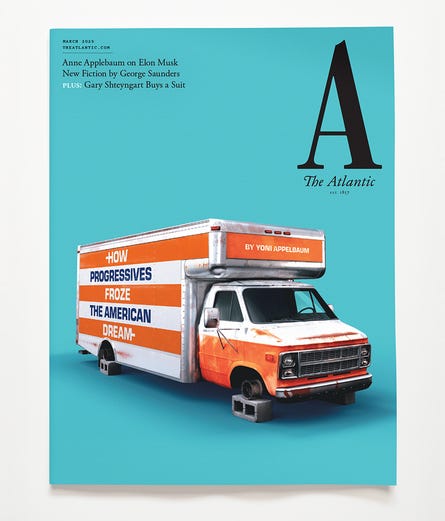
How Progressives Froze the American Dream (The Atlantic, Feb 2025). Most quotes in this essay come from this piece.
Stuck: How the Privileged and the Propertied Broke the Engine of American Opportunity
