
Redefining “Normal” Neighborhoods in North Carolina
Families can reclaim their time and communities by rethinking family housing
For generations, the “normal” American dream has meant a house, a yard, a driveway, and a car (or maybe two). Families have grown accustomed to the idea that raising children requires a detached home in the suburbs, far from the bustle of the city. Each household has their own yard, yet they must drive to reach somewhere engaging to walk around. Whether it’s a downtown in Cary or Apex, or a greenway trail around a lake, the vast majority of us need to drive to access nice areas.
This definition of normal has come at a cost: long commutes, fewer hours in the day, and communities spread too thin to walk anywhere worth going.
This piece was written by student fellows in collaboration with Single Stair NC. Each semester, CITYBUILDER provides fellowship opportunities for aspiring student urbanists in the Triangle. This semester we’re focused on single-stair apartments. Single Stair NC is a new publication committed to advancing the pursuit of single-stair buildings in North Carolina. Read more in our series:
Building Smarter: Why North Carolina Should Consider Single-Stair
Single-Stair Adds Homes Where Neighbors Want Them
Redefining “normal” means rethinking what family life can look like when we build homes at a human scale. It means designing neighborhoods that prioritize walkability, social connection, and shared spaces. What if more people could live within walking distance to a cute downtown, with fun shops and restaurants to hang out in? What if neighborhoods could be centered around community green spaces? What if your drive to drop your kids off at school could be a walk that also provides your dogs their morning stroll? One simple building type, the single-stair apartment, could be the key to this vision.
As housing challenges deepen and families search for more sustainable, livable solutions, it’s time to ask a different question: What would it take for a family to be comfortable in an apartment? Could changing the kinds of homes we build give families more freedom, more time, and more community? Doing the math reveals one thing: small-scale, single-stair apartments would grant families both the space to live and the time to enjoy it.
The Time Cost of Distance
Commuting by car to work every day is “normal” to the majority of people in North Carolina. In fact, nearly 96.8% of North Carolinians rely on a car to get to and from their jobs. The average commute time is 25 minutes each way, not counting school drop-offs, daycare runs, sports practices, or errands. That’s roughly an hour a day (five hours a week!) just spent getting to and from one singular destination.
For families, time is an especially precious commodity. Every extra minute in traffic is a minute not spent at home with loved ones, catching up with friends, or interacting with the community. But the way our housing is built continues to push people farther out from jobs. Large, single-family subdivisions stretch ever deeper into the outskirts of cities like Raleigh and Charlotte, consuming land and locking residents into longer commutes.
The result is a tradeoff that feels inevitable: space for distance, affordability for time. Yet the truth is, it doesn’t have to be this way. We can design family-oriented housing that reduces the need for a car and creates opportunity for more affordable housing, all while bringing daily life closer together.
Walking Through “Normal” American Neighborhoods
When we talk about “walkability,” it’s easy to imagine sidewalks and crosswalks. But true walkability is not about infrastructure, it’s about experience. People choose to walk when the journey feels safe, pleasant, and interesting.
Think about a memorable walk in a city or town you’ve been to. Chances are, you remember what you passed along the way: shop windows, porches, trees, street corners buzzing with people. These small, sensory details make walking enjoyable. Conversely, walking through a parking lot or beside a four-lane road feels monotonous and unsafe.
Currently, our cities are built around the logic of roads, so sidewalks follow alongside where cars go. But what would happen if we flipped that logic? What if our street networks were guided first by the paths people naturally want to take, and cars were secondary?
That’s what walkable design seeks to do: to build places where people, not vehicles, set the scale of movement. That shift has the potential to reshape how families live, move, and connect.
Living at Human Scale
“Human scale” is a phrase urban designers use often. A human-scaled neighborhood is one you can understand and enjoy at walking speed. It’s made up of shorter blocks, narrow streets, ground-floor windows, and front doors that open right onto the sidewalk. It feels alive, and, by the very nature of its design, promotes social interaction
By contrast, a car-scaled environment is oversized: wide lanes, deep setbacks, and vast parking lots. These spaces might work for traffic flow, but they make walking uncomfortable and even dangerous in some areas. Car-scaled environments effectively force us into our cars if we’d like to travel anywhere outside of our houses.
One of the most powerful ways to return to human scale is to rethink parking. Imagine a large asphalt parking lot, sitting empty for most of the day. If that land were used instead for homes, small shops, or green courtyards, it could house dozens of families and create public spaces worth walking through. We could even replace that parking lot with a parking deck, which would serve the same number of cars, but preserve surface area for other neighborhood attractions.
When people can walk to a corner store or café, retail thrives, foot traffic grows, and there’s less need for widespread surface-level parking. A simple reallocation of space, just replacing asphalt with activity, can fundamentally shift how people experience their neighborhood.
Visualizing this change helps: picture a downtown Raleigh street in two frames. One shows the existing car-dominated layout; the other, a tree-lined pedestrian route with housing, stoops, and storefronts. The distance for residents stays the same, but the experience transforms.
The Perfect Apartment for Families
Enter the single-stair apartment: a modest but game-changing idea in housing design.
In most large apartment buildings, long hallways connect dozens of units, all served by two or more enclosed stairways. These corridors take up valuable space that could otherwise be used for living areas, balconies, or courtyards. A single-stair design removes that excess, connecting just two apartments per floor to one light-filled stairway.
The result is smaller buildings, typically three to five stories, that fit comfortably on a neighborhood block. They feel more like townhomes than towers. Each home gets more light, ventilation, and privacy. And because these buildings are compact, more of them can fit on the same parcel of land, increasing housing supply without overwhelming existing neighborhoods.
Single-stair housing naturally supports walkability. With more doors open directly to the street, neighborhoods gain rhythm and variety. Instead of one massive apartment complex set behind a parking lot, you get multiple entrances, stoops, and shopfronts lining a block. These are the kinds of details that make walking interesting, and make streets feel safe.
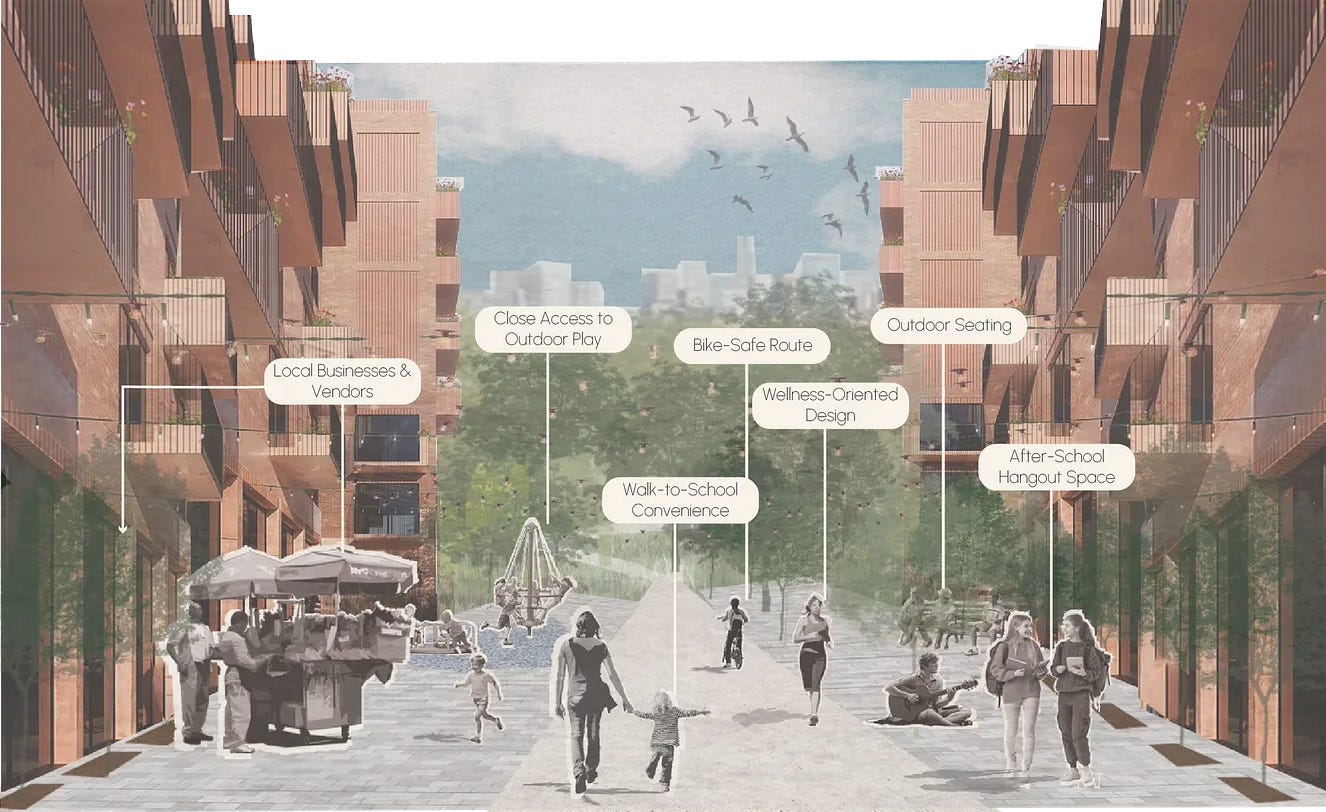
A rendering of a single-stair community might show what’s possible: clusters of mid-rise homes around shared courtyards, with trees, gardens, and a café or daycare on the ground floor. It’s a modern reinterpretation of what neighborhoods once were: dense, varied, and human-centered.
“Hey kiddo, time to walk to school!”
Despite the demand for family housing, most urban construction in North Carolina focuses on smaller units: studios, one-bedrooms, and two-bedrooms. Meanwhile, 64.5% of households in the state are families, and 65.3% of all homes are single-family, detached structures. That means the majority of families have little choice but to live far from city centers, where larger homes are available.
As the demand for homes in proximity to those city centers increases, the cost of homes everywhere continues to increase, and the affordable homes get pushed farther and farther away.
If we want families to return to urban areas, our local governments need to legalize the right types of housing: homes with three or four bedrooms, access to outdoor play areas, and safe streets for kids.
Single-stair buildings are especially well suited to this. With only a handful of apartments per floor, they can be designed for families:
Shared courtyards become play areas where children can interact safely.
Ground floors can host small shops, daycares, or cafés that make daily life more convenient.
Front doors that open to the street build connection among neighbors, the same way front porches once did.
The benefits of familial life in walkable, mixed-use areas abound. Parents can walk to work or errands; kids can safely walk to school or parks. The entire rhythm of daily life changes. By avoiding car travel, we can reclaim time for socializing, and commuting time is spent exercising rather than sitting.
Take a look at the school above: a prime example of how much valuable land is wasted on space for carpools. Currently, school zoning around the Triangle requires there to be space for the majority of the cars that would be picking up children at dismissal. That land could be used for new classrooms, an upgraded playground, or outdoor gardens to eat lunch, if only the cars didn’t need to be there. These updated amenities would be possible if we legalized single-stair housing, putting more families within walking distance of school.
When we build only one kind of housing (like single-family homes or luxury towers), we also limit who can afford to live there. But when we mix townhomes, single-stair apartments, and small mixed-use buildings, we attract a broader demographic: students, seniors, families, and professionals. This mix of ages and incomes strengthens communities and makes local businesses more resilient. The space to incorporate these diverse, medium-scale building types already exists within our cityscapes; it’s just a matter of allowing these building types within our code to make it possible.
Economically, increasing the supply of homes in desirable areas also lowers the cost per unit. That’s one of the simplest, most powerful tools for addressing affordability. Rather than pushing families to the fringe, moderate-density housing can bring them back into walkable neighborhoods without sacrificing livability.
What Could Be Possible?
So, what would a neighborhood look like if we allowed more single-stair buildings by code?
Imagine a large suburban parking lot: flat asphalt, ringed by retail stores. Now rework it: consolidate the parking into a deck and fill the freed land with a mix of apartments, cafés, and green courtyards. Sidewalks wind between shaded seating areas, a daycare opens onto a play lawn, and small shops face the street.
Architect Robert Orr, FAIA, calls this approach “creating small blocks where none existed.” It’s about stitching together neighborhoods at a finer scale, not replacing them. These buildings can coexist comfortably with older homes and streetscapes, offering more housing without overwhelming the character that residents value.
Single-stair communities are different than typical urban developments. They don’t look or feel like high-rises. They don’t cast long shadows or bring massive parking structures. Instead, they allow more people to fit into the neighborhoods we already know and love. A family-owned coffee shop could move into your street corner, or a community garden could be in your neighbor’s backyard. By altering our status quo of starkly separating residential and commercial areas, we can make a neighborhood that benefits all of us.
The same land now supports dozens of families, a thriving retail environment, and a walkable network of public spaces, all without adding new roads or traffic. With careful design, this vision could fit seamlessly into many North Carolina communities. We believe it isn’t too late to transform our car-oriented corridors into vibrant, human-scaled environments.
Redefining Normal
To redefine “normal” is not to abandon tradition; it’s to reimagine our built environment for today’s realities. Families still want comfort, safety, and belonging. But they also want time: time to walk their kids to school, to know their neighbors, to spend less of life behind a windshield.
The path to that future runs through walkability, mixed-use design, and innovative housing like the single-stair apartment building. Single-stair can allow us to create a new “normal”; one that prioritizes community interaction and neighborhood integration. If we start to see “normal” not as detached isolation but as connected community, we can build a world where homes, shops, and parks are all within walking distance: a world scaled to people, not cars.
And perhaps, someday soon, single-stair housing can provide a new experience of “normal” for family life.
Julie Powers is a Bachelor of Architecture Student at NC State University, with a LAEP minor. Additional graphic and illustration support was provided by NC State Undergraduate College of Design in Architecture major Brenna Belcher.


Great writing from Julie Powers!