VERBATIM is a series that republishes the words of local leaders supporting better cities.
During the March 17th Bicycle and Pedestrian Advisory Commission (BPAC) meeting in Durham via Zoom, City Council members Matt Kopac and Carl Rist stated the importance of reforming Durham’s land use policies in the new (but stalled) Durham Land Development Code (LDC, née UDO).
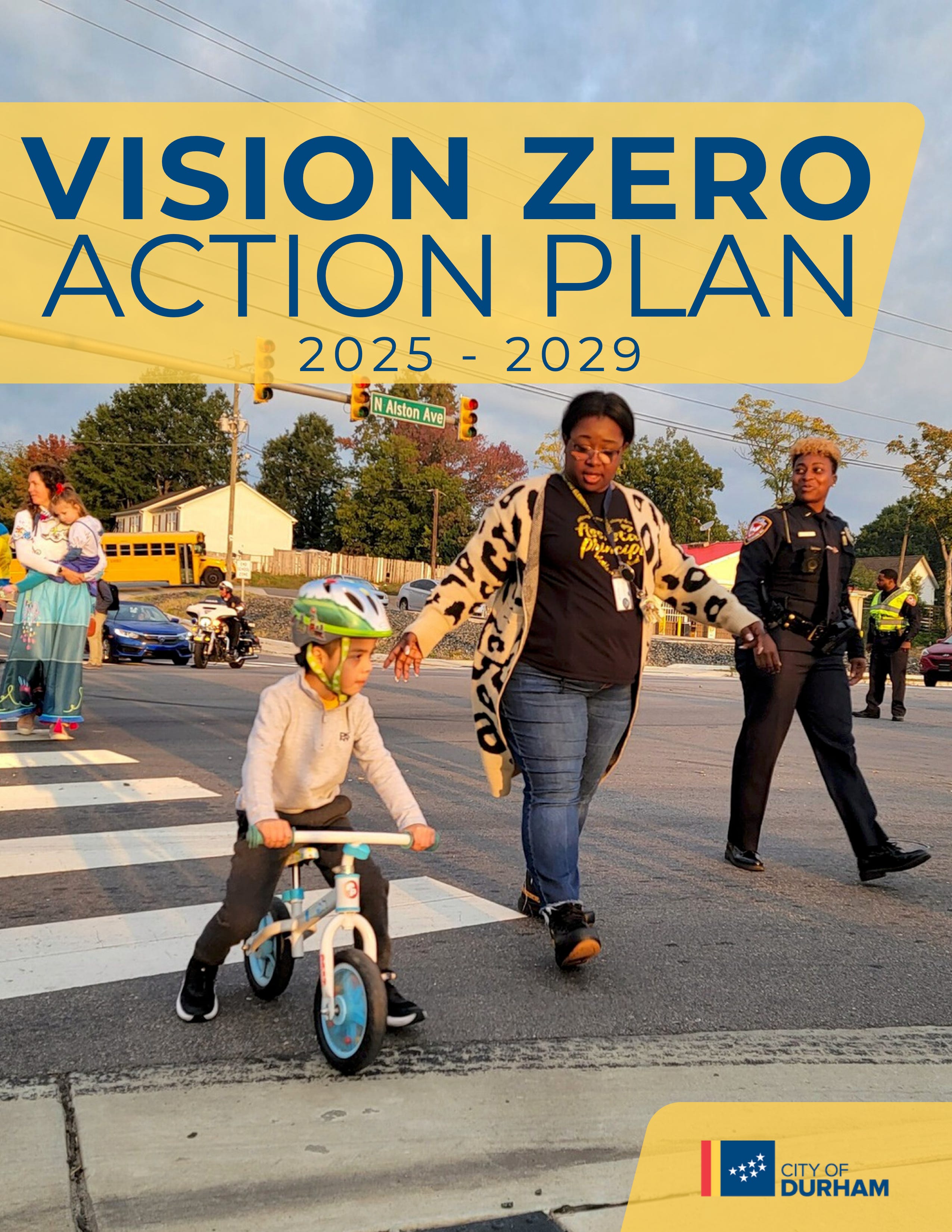
Per Action 1 of the unanimously passed Vision Zero Action Plan, “Update Land Use Policy,” changing land use practices to limit vehicle miles traveled will be critical in achieving Durham’s Vision Zero Goals.
Vision Zero is a a global strategy aimed at eliminating all traffic fatalities and severe injuries. Durham adopted a Resolution Committing to Vision Zero in September 2017, aiming to reduce traffic deaths and serious injuries by 50% by 2035 and achieve the goal of zero fatalities and serious injuries on Durham roadways by 2045. Durham is not on track to meet these targets.
Land Use regulations dictate which uses – agricultural, industrial, commercial, residential, etc. – are allowed which locations. Critically, land use regulations are also used to determine how much of these uses are allowed in those locations, and have been used to enforce low-density development patterns (AKA sprawl). Vehicle Miles Traveled (VMT) refers to how far people drive in their cars. Scholars and advocates agree, we can decrease traffic fatalities by decreasing VMT, and we can reduce VMT by increasing density.
During budget discussions at a recent BPAC meeting, an advisory commission member noted that any debates affecting transit, parking, and street safety must be considered in the context of Durham’s unanimously adopted Vision Zero Action Plan.
The commission member reminded those present that the Action Plan identifies reducing vehicle miles traveled as one of the most important ways to reduce deaths and serious injuries from traffic violence, which makes land use, parking policy, and transit investment central to achieving the city’s stated safety goals.
While acknowledging that funding gaps and process constraints make progress harder, the commission member argued that Durham has already seriously committed to ambitious Vision Zero targets, and needs to commit to making steady progress, rather than falling further behind.
Councilmember Kopac Responded:
[...] I'll say that I do absolutely support the Vision Zero action plan, [...] and Commissioner [Wendy] Jacobs mentioned earlier, you know, the LDC is a crucial part of this too in encouraging growth patterns that support greater density in more urban areas closer into the city in high demand areas where you can have more mixed use. And so the budget is crucial, but let's not forget the land use piece [...] I'm curious what BPAC's role is. And I'm sorry if this is out of order, [BPAC President] Mary Rose [Fontanta], but I'm curious what BPAC's role has been around the LDC so far. If you've done any advocacy around it, if you've, you know, taken a position on any of the elements in it to help support your goals.
In response, a commission member explained that the BPAC’s LDC Task Force had focused mainly on bicycle and pedestrian provisions, including infrastructure and parking, but not land use changes, nor questions around where growth should go – not because BPAC members opposed Vision Zero’s tactics, but because they focused on design elements that were more tied to BPAC’s scope.
Councilmember Rist Responded:
Yeah, if I could jump in on this also, Mary Rose, I think that's right. I think you know BPAC was addressing the specific sort of bike pedestrian elements in the LDC, but I do think it's worth individual members of BPAC considering, when this thing – I mean, I'm guessing this is going to come to a vote hopefully by the end of the year – it's going to be a battle. It's gonna be a battle. I think as we talked about on the call here, it's not just about how the LDC can support, you know facilitate bike and pedestrian infrastructure, but also how the built environment does support a much more safe and accessible way to get around the city. So, I'd encourage all the members of BPAC to think about individually supporting the LDC because […] it's going to be a big battle.
CITYBUILDER agrees. To advocate for our communities to be places where we can walk and bike safely cannot be disentangled from the work of remediating the land use standards that created our current sprawl and car-dependent development patterns. We need more housing, and we need it close to other housing (and shops! And Work! And parks!). This is the density needed for us to bike and walk safely through our cities and towns.
Be sure to stay tuned to CITYBUILDER for updates regarding Durham’s new LDC, and for innovations and insights from across the Triangle to find out more about which local places are successfully supporting land use that allows for more housing located closer to places of employment, education, and services.
Stay safe out there.