

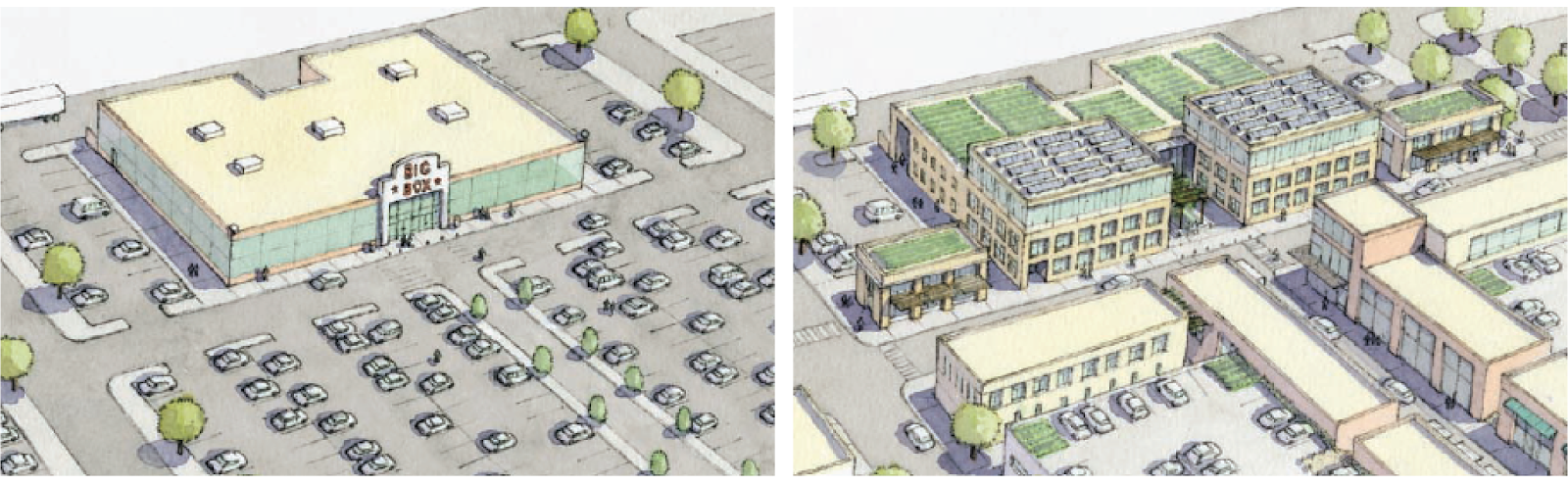
Look at any new mixed-use development in the Triangle and you’ll see the same thing: beautiful storefronts, polished plazas, thoughtfully branded apartment buildings… and a sea of parking separating it all from the neighborhoods next door. Mixed-use districts promise walkability, vibrancy, and density. Single-family neighborhoods promise stability, privacy, and calm. But between them? Four-lane roads, surface parking, retention ponds, and zoning walls. The result is a landscape of fragmented, isolated destinations.
If we are serious about building connected communities, single-stair housing must be legalized in the building code. It would be the most effective bridge we have between mixed-use districts and existing suburban neighborhoods.
Our Existing Urban Fabric: a Tapestry Torn Apart
Drive through North Raleigh and you’ll see townhomes backing up to strip malls. A wooden fence separates patios from parking lots. While technically adjacent, the built environment creates barriers that disconnect these destinations and prompt the use of cars for short trips.
This piece was written by CITYBUILDER student fellows in collaboration with Single Stair NC, a new publication committed to advancing the pursuit of single-stair buildings in North Carolina. Read more in our series:


A typical American strip mall faces towards arterial roads, with parking lots outside the storefront. This configuration neglects the people living in close proximity to the strip, where vegetation or fences block off walkable paths. In these buffer areas, mid-rise, single-stair apartments could provide a gradient between commercial and residential zones. By fronting the commercial street, stepping down in height toward the townhomes, and activating the sidewalk with small retail or residential stoops, single-stair buildings would make both residents and customers feel like they belong in the urban environment.
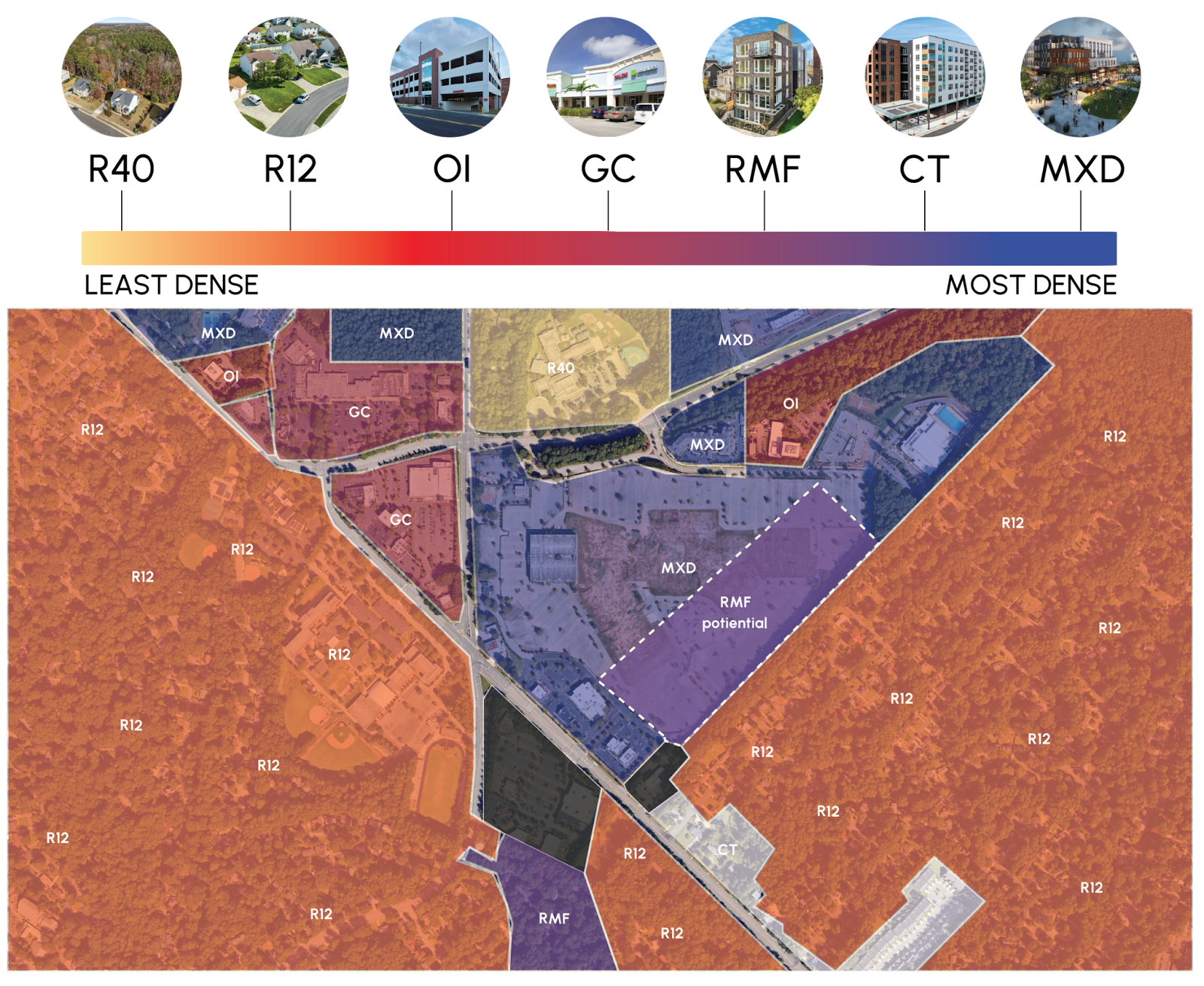
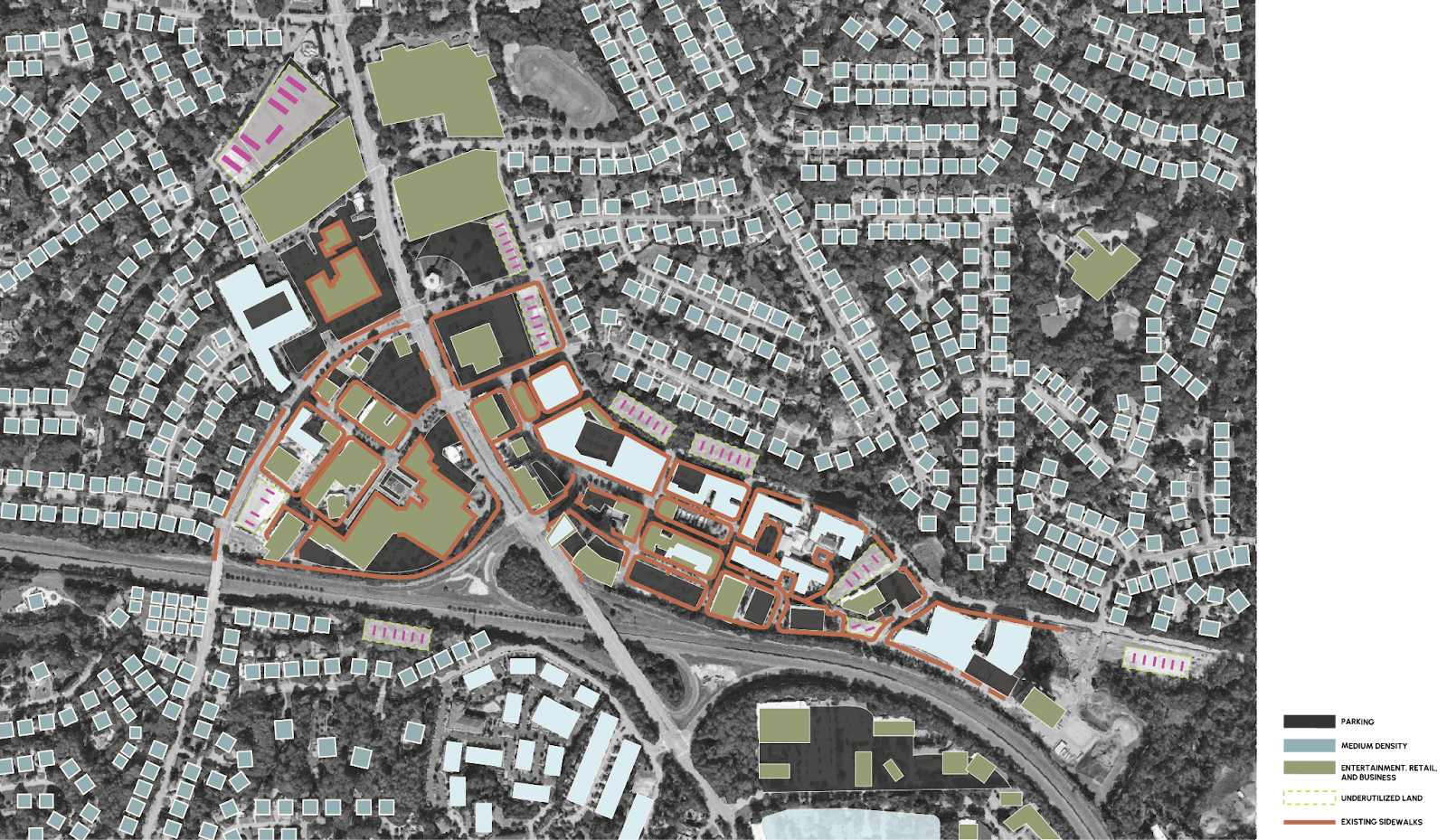
The above diagram illustrates how Cary Towne Center could be reimagined with mixed-use and residential multifamily housing to better integrate with its surroundings. By utilizing the vacant parking spaces, much needed medium-density housing could be created right next to mixed use zoning. If large-scale apartment buildings with first floor commercial developments were to be created in the MXD (Mixed Use District) zone, single-stair buildings in the RMF zone would serve as both a buffer and a connector between commercial establishments and the existing neighborhood.
Fenton and Southpoint Mall: Gorgeous in Plan, Failure in Practice
Fenton is one of the Triangle’s newest mixed-use districts. It has apartments, restaurants, offices, and curated public space. On paper, it’s a success, but think about the journey to get there… It requires a car ride and a walk from a parking lot or deck. Anyone in the adjacent neighborhoods is forced to walk along Maynard Road or Cary Towne Boulevard because there are no sidewalk connections directly from those neighborhoods. The result is Cary Towne Boulevard and Walnut Street functioning more like defensive perimeters than connective tissue, since those transportation arteries are built for cars.
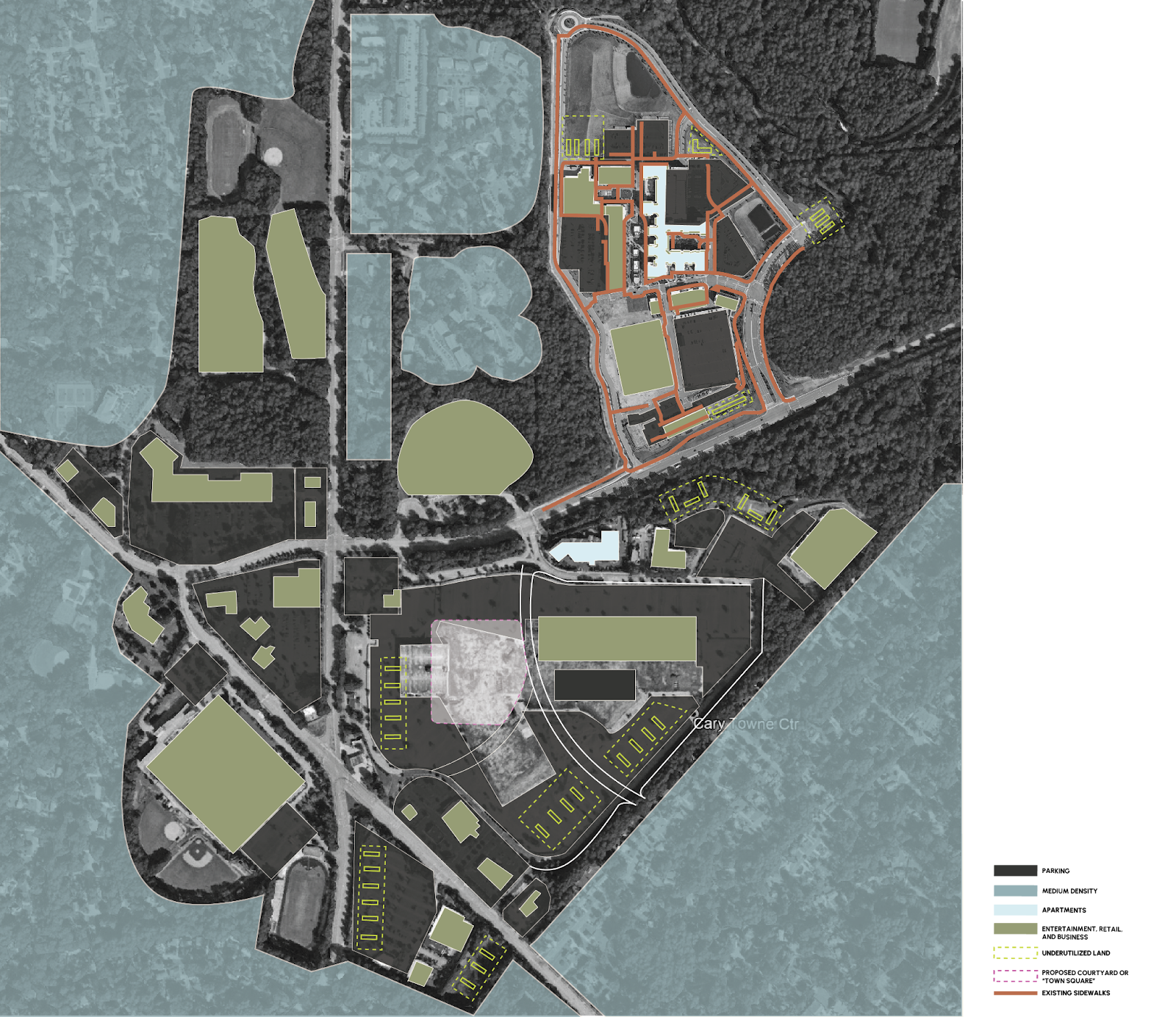
The former Cary Towne Center site embodied the same pattern prior to redevelopment: a mall ringed by parking, accessible primarily by car, designed for peak occupancy rather than everyday integration.
The irony? Malls contain exactly what people say they want from urban living: restaurants within walking distance of shops, public gathering spaces, outdoor plazas, and social activity. As someone who grew up in the Triangle, “going to the mall” wasn’t an errand… it was an afternoon. My friends and I would walk around the plazas at The Streets at Southpoint for hours before grabbing lunch in the food court. And with Chris “Juggle Boy” Fowler performing in the open-air corridor, it felt like a town square.
The catch: Southpoint is a town square surrounded by a field of asphalt.
What if those edges were wrapped in mid-rise, single-stair buildings instead of parking spaces? What if the parking was structured and tucked behind? What if the development bled seamlessly into adjacent residential blocks?
North Hills: A Promising Local Precedent
North Hills along Six Forks Road works beautifully as a high-density node. With towers, retail, and offices, it’s decidedly urban in form and experience. These urban nodes serve a vital role, providing social centers for people and corporate hubs for businesses. We need increased density at all scales, and single-stair housing enables increased density on lots that are too small for large apartments or condos. With the integration of single-stair housing, North Hills would contain more versatile housing options, and would regain some of the neighborhood character that struggles to find expression in large apartments.
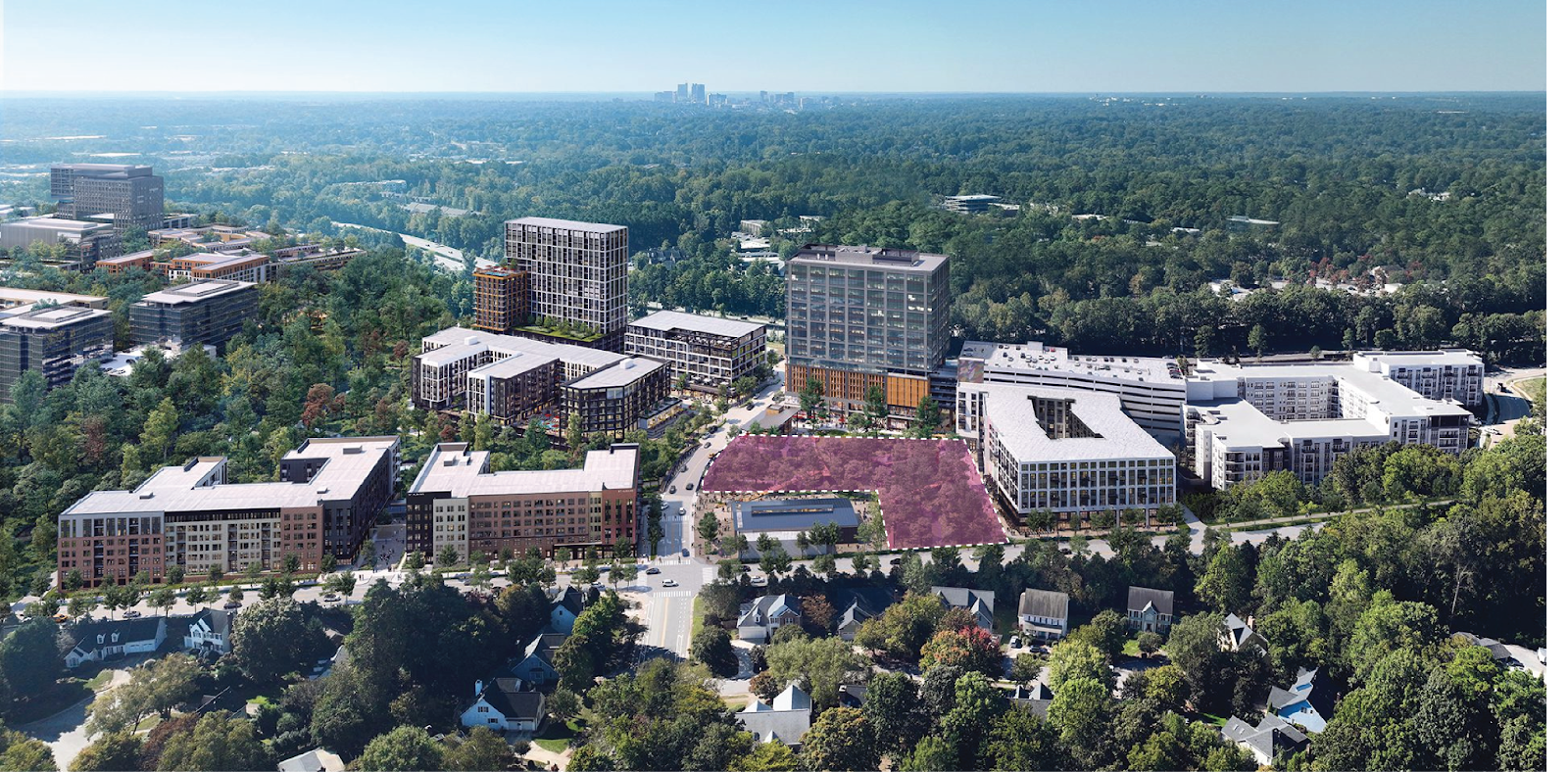
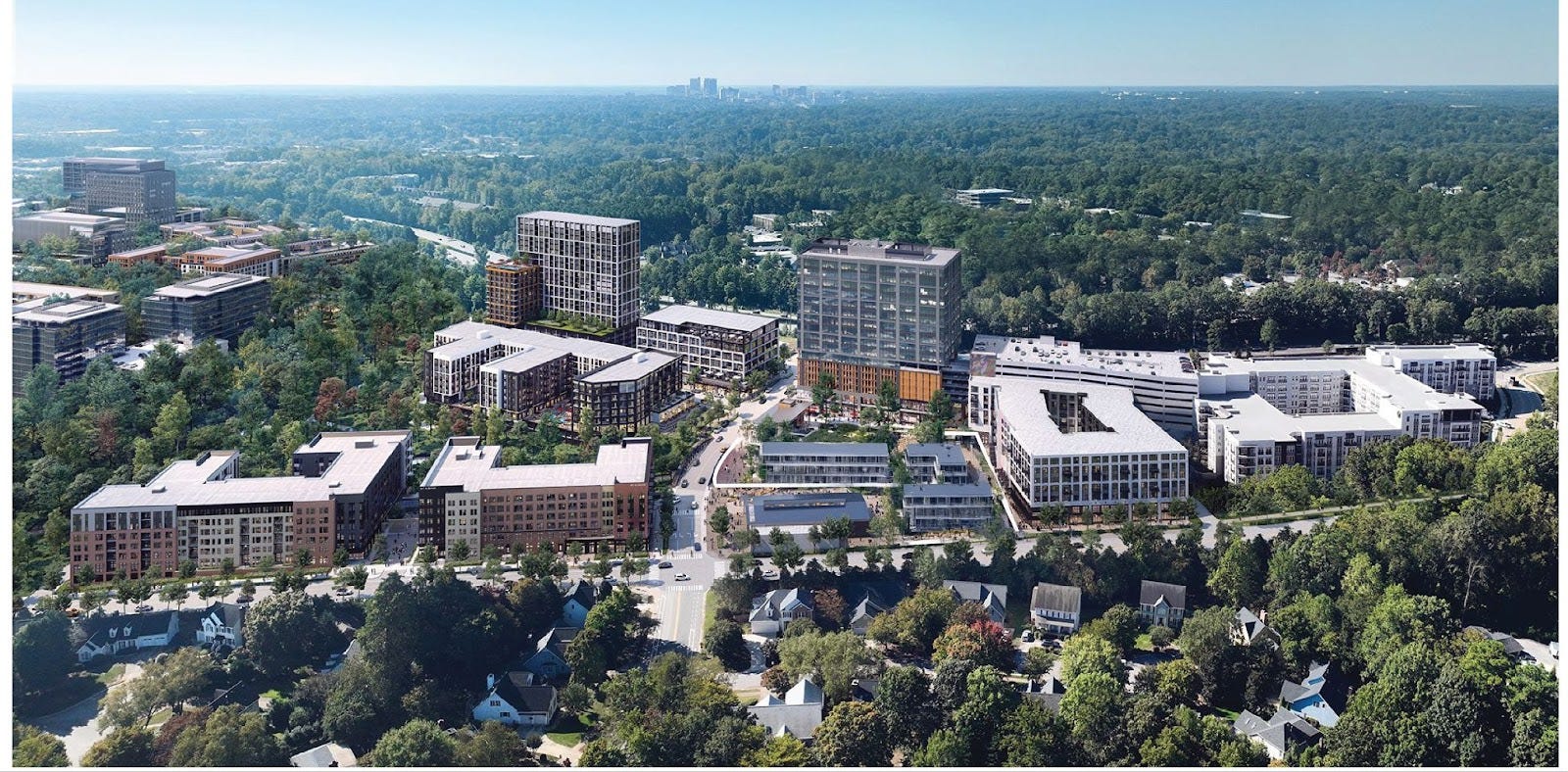
As is, the seam between North Hills and the surrounding neighborhoods can feel harsh. However, this isn’t a failure of density increases, it’s a failure of building typology and zoning allowances. When a developer’s only multifamily tool is a double-loaded corridor building requiring two stairs, elevators, and large floorplates, you end up with big block apartments or nothing at all. On top of this, infill lots become infeasible and undesirable.
The integration of single-stair buildings into an urban network like North Hills would allow for more comfortable transitions between existing neighborhoods and new developments. Infill within the mixed-use district would make the entire area feel more like a neighborhood. Shallow lots unfit for high rises could be used for single-stair housing, creating a well-utilized buffer between destinations.
Why Single-Stair Works
New York City, Chicago, and Boston are enjoyed by millions of tourists every year. Part of the charm of these cities is their walkability. Parks, local restaurants, and coffee shops tucked into small lots along the sidewalk provide moments of interest and exploration. These destinations alongside a walkable streetscape is a feature that many post-industrial cities lack. Most modern American municipalities were created with cars as the primary mode of transportation; as a result, the pedestrian experience was left in the dust.
Single-stair buildings enabled the formation of walkable avenues throughout Europe and North America, but this walkability was hampered when modern code changes in the United States mandated dual means of egress for most multifamily buildings over a certain size.
Legalizing single-stair buildings with modern fire safety standards would restore a number of positive dynamics to our urban networks, from unlocking small-scale developer opportunities to improving the lighting and ventilation in units. The first floor of these structures could be made into local coffee shops, restaurants, and stores, while gaps between buildings would supply niches for small parks and green space.
But What About Parking?
It’s no secret that shopping in America requires a significant amount of parking spaces. In the development of single-stair buildings on small infill lots, parking poses a significant challenge. The lack of space for a large-scale apartment means that there is also very limited onsite space for parking to exist. Commercial shopping malls offer a unique chance to solve this problem by creating a dynamic in which parking that goes underutilized in off-peak hours could serve as parking for single-stair residences.
Because residential parking and commercial parking tend to be used at opposite times of day, an opportunity exists for the same parking lot to serve a dual-purpose. The residents of medium-density housing could utilize a portion of these commercial parking spaces during businesses’ closed hours (mainly at night and in the morning). Conversely, customers who drive to businesses during the day would fill these same parking lots when residents need them the least (during work hours). This way, parking lots could transform from some of the most underutilized spaces (sitting empty at night and in the morning) to land that is always being used.
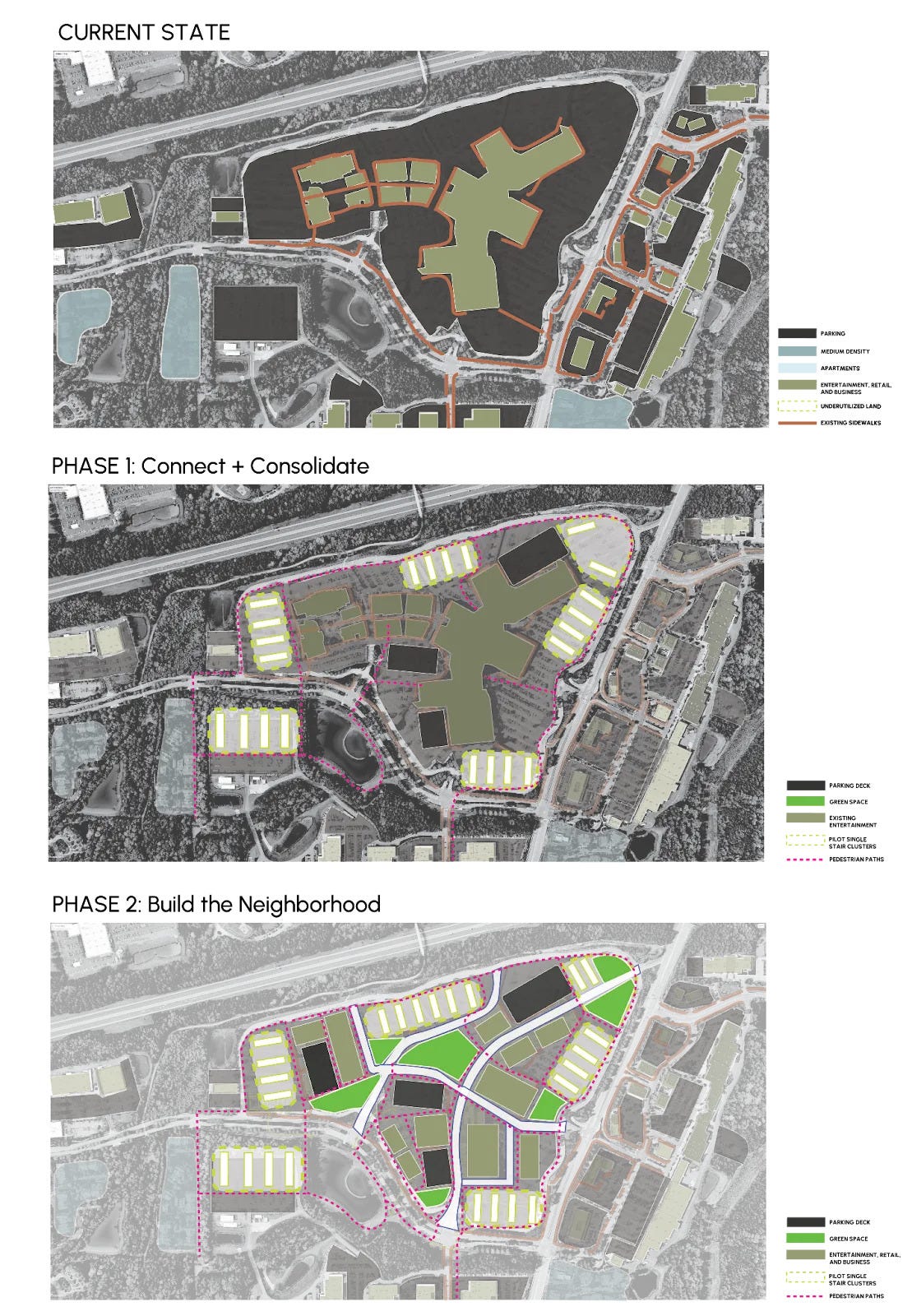
When medium-density housing is absent from the equation, you get Fenton. Fenton’s original masterplan makes use of well placed parking decks and green spaces to create a comfortable, mixed-use district. What ended up getting built faces many of the same problems as traditional shopping malls: vibrant, central shopping spaces, lined with a “moat” of parking that sits vacant outside of peak hours.
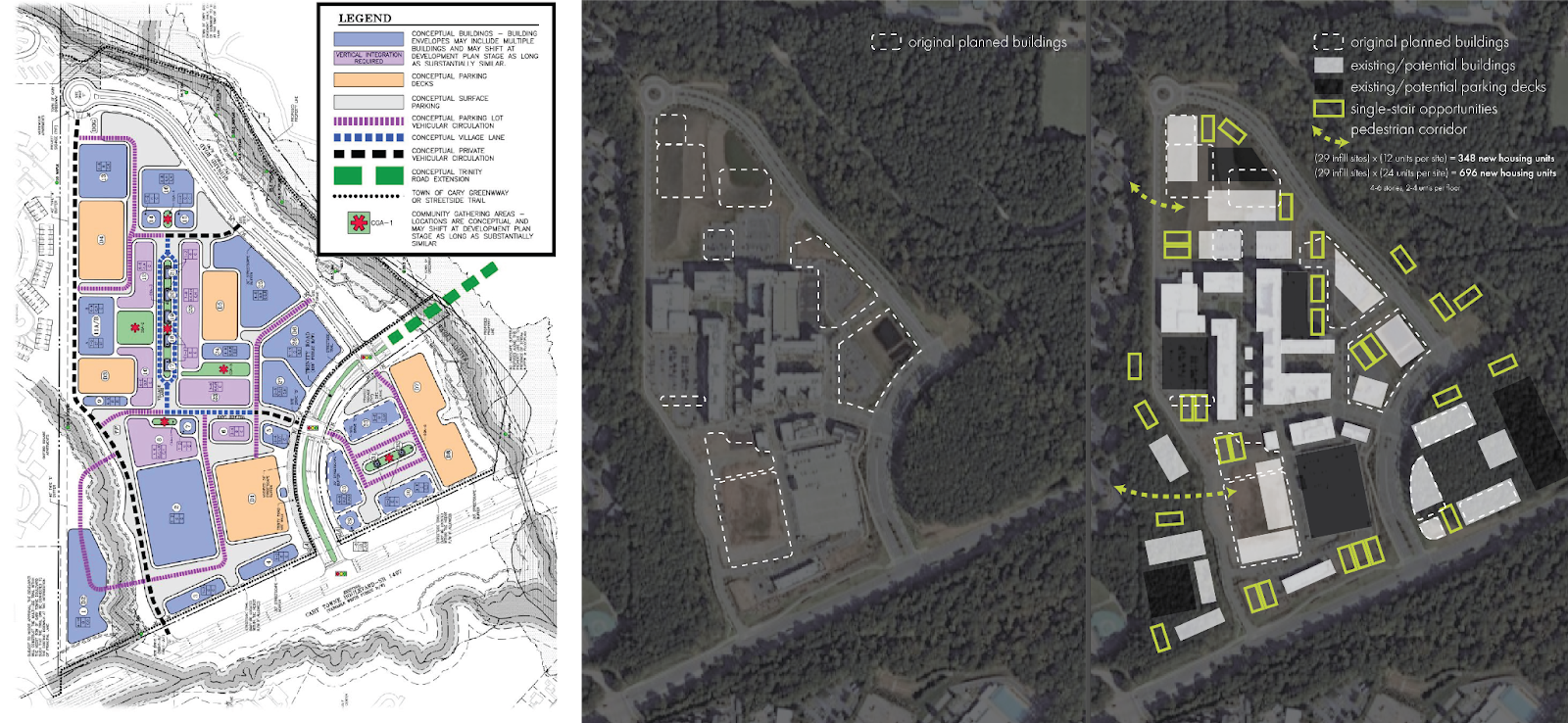
The diagram on the right takes the existing layout and consolidates its parking into a few large decks, while highlighting where single-stair buildings could fit on the regained land. This is where single-stair apartments would excel: filling in small, oddly shaped sites in ways that hulking double-stair apartment blocks never could.
In North Hills, an abundance of parking infrastructure already exists underground for commercial entities. Medical facilities, retail, and a nearby grocery store provide amenities for people within walking or biking distance, further reducing the need for a car. This combination of factors makes North Hills an ideal location for single stair integration, where additional onsite parking may be a challenge.
Visualize the Retrofit
Picture the scale of North Hills. Now overlay slender 18-unit single-stair buildings along its residential edge. Step them down toward adjacent neighborhoods. Add small corner cafés or live-work sites. Insert mid-block pedestrian paths.
Imagine Fenton. Replace peripheral parking lots with a series of 4-story single-stair buildings. Connect them to surrounding subdivisions through landscaped pedestrian corridors.
Take the aging strip centers across Wake County. Instead of redeveloping them as one massive mixed-use block, allow incremental infill throughout unused lots and parking lots… one small building at a time.
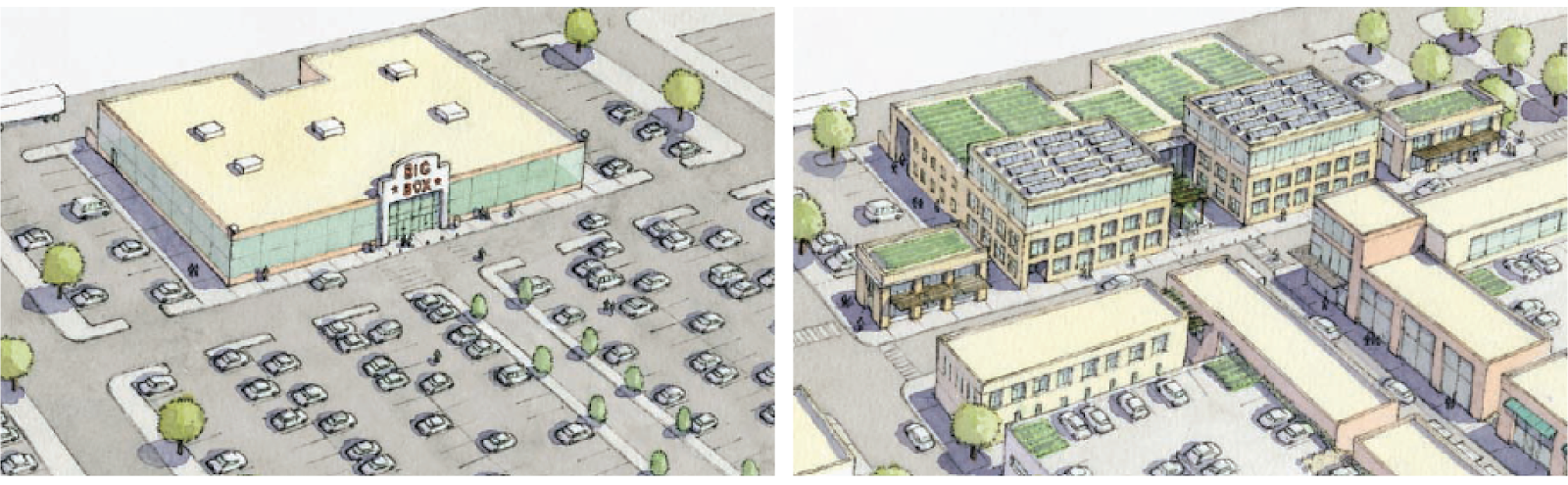
Our mixed-use districts and malls are headed in the right direction: walkable retail and restaurants, public plazas, and flexible spaces for social interaction. Yet, they fail in one massive way: connection outside of themselves. Our malls and neighborhoods shouldn’t be bubbles, and our parking lots shouldn’t act as castle moats. If we want truly walkable communities in Raleigh, Cary, Durham, and beyond, we need typologies that transition, instead of dominate.
Single-stair buildings are small enough to fit, flexible enough to adapt, and powerful enough to stitch together what zoning and asphalt have pulled apart. The question isn’t whether we can build vibrant mixed-use hubs. We already do. The question is whether we’re ready to connect our neighborhood network.
This piece was written by student fellows in collaboration with Single Stair NC.
Each semester, CITYBUILDER provides fellowship opportunities for aspiring student urbanists in the Triangle. This semester we’re focused on single-stair apartments. Single Stair NC is a new publication committed to advancing the pursuit of single-stair buildings in North Carolina.
Julie Powers is a Bachelor of Architecture Student at NC State University, with an LAEP minor. Additional graphic and illustration support was provided by NC State Undergraduate College of Design in Architecture major Brenna Belcher.


